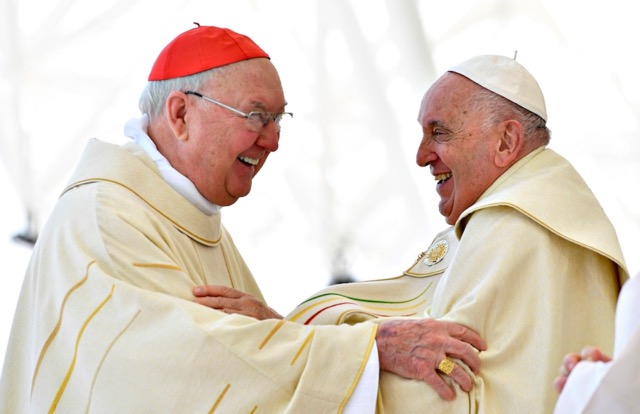
Kevin Farrell, the camerlengo, with the late Pope Francis. His role was similar, but distinct from that e of Cardinal Thomas Lawrence in the film ‘Conclave’, as portrayed by Ralph Fiennes, who is also the Dean of the College of Cardinals
Luke Wadding was as close to an Irish pope as we’ve ever had – or certainly until 21 April 2025 when Cardinal Kevin Farrell from Drimnagh announced the death of Pope Francis and basically ran the Vatican City as camerlengo — or “chamberlain” — for 17 days until the the election of Pope Leo XIV on 8 May. Having verified the pope’s death, Cardinal Farrell took possession of the Ring of the Fisherman, and oversaw the preparations for the conclave and the pope’s funeral.
‘Padre Luca’ Wadding established the Irish College in Rome, which would be preeminent amongst the 29 Irish Colleges in Europe. A brilliant theologian and an exceptional diplomat, he also sowed the seeds for the global phenomenon of St Patrick’s Day.
*****
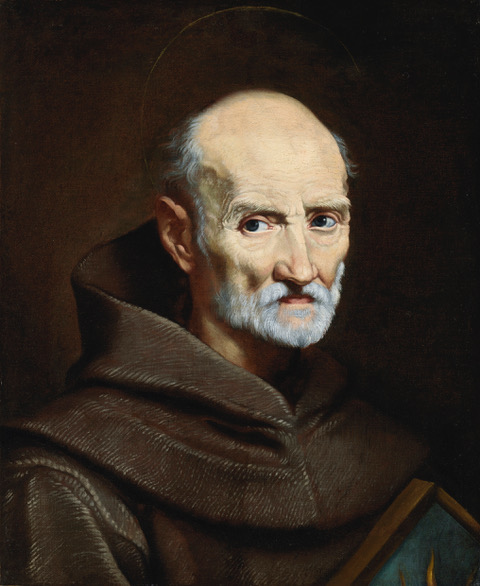
Luke Wadding’s portrait in oil is attributed to Jusepe Ribera after Carlo Maratti, who also supplied drawings for engravings. It was subsequently acquired by the National Gallery of Ireland.
Rome, 1618. For thirty-year-old Padre Luca, that first visit to the Franciscan church of San Pietro on the Janiculum Hill must have been a moment of profound resonance. This, it was widely believed, was the very site on which St Peter had been crucified by Emperor Nero. Of rather more recent relevance were the tombs by the high altar where Hugh O’Neill, the Great Earl of Tyrone, and Rory O’Donnell, Earl of Tyrconnell, lay buried.
Padre Luca, or Luke Wadding as he was christened, was living in the Portuguese city of Matosinhos in 1607 when he learned that a ship laden with some of the most prominent Gaelic Irish aristocrats had arrived in the Continent from Ireland. War-weary and landless, Tyrconnell had died in Rome shortly after his arrival in the summer of 1608, leaving a two-year-old son, Hugh O’Donnell, as his heir. [1] Lord Tyrone, the head of the O’Neill clan, lived on until 1616, having spent his last years vainly plotting a return to Ireland.
The ‘Flight of the Earls’, as their 1607 departure became known, marked the end of the Gaelic order in Ireland. And yet the decision by the two earls to go to Rome, the city where Luke Wadding was also to spend the rest of his life, simultaneously marked the start of a much deeper relationship between Irish Catholics and the Eternal City.
Such synergy would probably not have been possible without the genius of Padre Luca himself. This modest Franciscan friar established the Irish College in Rome, which would be preeminent amongst the 29 Irish Colleges established in Europe at this time. A brilliant theologian and an exceptional diplomat, he also sowed the seeds for the global phenomenon of St Patrick’s Day.
Luke Wadding was born in Waterford in 1588, just weeks after a third of the King of Spain’s Armada was wrecked along the Irish coast. He was one of ten brothers (with four sisters) born to Walter Wadding, a well-heeled merchant, and his wife, Anastasia Lombard.[2]
He received an excellent early education in Waterford, numbering his own father and his older brother Mathew, a merchant, amongst his most attentive teachers.[3] Tragedy struck in 1602 when both Walter and Anastasia succumbed to plague. The following year, Mathew brought him to Portugal where he commenced his studies at the University of Coimbra. [4] Another brother Ambrose went to the Jesuit University of Dillingen in Bavaria where he would become a celebrated professor.
In September 1604, he entered the Order of Friars Minor, better known as the Franciscans, and made his profession a year later. Having spent his novitiate at Matosinhos, he went on to become a theology lecturer at the University of Salamanca.[5] An exceptional linguist, he was by now fluent in Portuguese, Castilian and Hebrew, as well as Greek, Latin, English and Irish. Mastering Italian, when the time came, was no problem to of Padre Luca.
Luke Wadding’s special interest in the doctrine of the immaculate conception of the Virgin Mary caught the eye of a Spanish bishop who invited him to serve as his theologian on a delegation to the Vatican City in Rome, where the Franciscans were also headquartered. [6]
Upon his arrival in Rome in 1618, Luke was accommodated by Spanish Franciscans living near the church of San Pietro, where the Irish earls were buried. He was later introduced to the 2nd Lord Tyrconnell, now a teenager, who was so impressed by Luke’s ‘merit and talent’ that he urged the pope to make him Bishop of Waterford.[7] Tyrconnell’s mentor, Florence Conry – the Archbishop of Tuam, another Franciscan friar in exile – likewise applauded Wadding as a man of ‘great intelligence and discipline.’ Such endorsements were further enhanced when Luke united with his mother’s cousin Peter Lombard, the exiled Archbishop of Armagh, who had been living in Rome since 1598.[8]
Lombard, who had been Hugh O’Neill’s agent in Rome prior to his elevation to the archbishopric, was held in high esteem by the Vatican for his theological prowess. A close advisor to Pope Paul V, he had just concluded his business as head of a committee of consulters to the Holy Office investigating the Copernican world-view espoused by the philosopher, Galileo Galilei. Lombard’s committee concluded that the Copernican theses was ‘false and altogether opposed to Holy Scripture.’ The work of Copernicus and several sympathetic treatises were consequently banned.
In the spring of 1619, Beningno da Genova, the Minister General of the Franciscans, asked Luke to write the definitive history of the 400-year-old order. This colossal project would occupy much of Luke’s time for the next three decades before he finally completed the eight-volume work, Annales Minorum, published in 1654. It also made the Waterford native one of the most influential men in the Vatican because not only was he granted unprecedented access to material on the Order but he was also now meeting or corresponding with the leading figures from the miscellaneous Franciscan branches, including Urban VIII, who served as pope from 1623-1644, and the powerful Barberini and Ludovisi families.
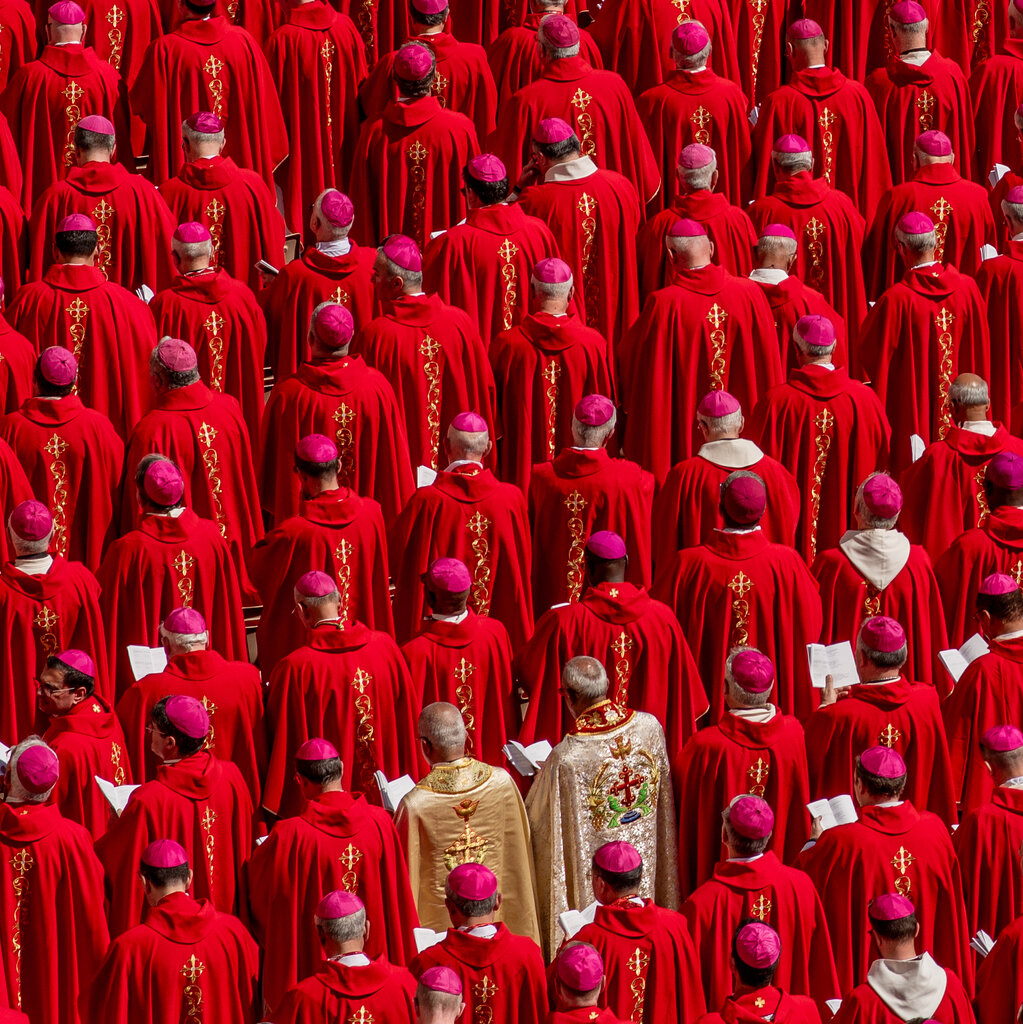
The funeral of Pope Francis, 26 April 2025.
Arguably the most important of these contacts was Ludivico Ludovisi, the ambitious and immensely wealthy nephew of the late Pope Gregory XV. Cardinal Ludovisi lived in a gorgeous villa that he had built on Monte Pincio and filled with a fabulous collection of Roman antiquities along with frescoes and other works by contemporary artists. The villa lay a stone’s throw from the small friary of St Isidore’s, founded by a small group of Spanish Franciscans in 1621.[9] When the Spaniards ran into difficulty and left Rome, the friary was offered to Luke Wadding as a base where missionaries could be trained for the Irish Franciscan province.
Luke readily accepted the challenge. Part of his raison d’être was to prove to the wider Catholic world that Franciscans were by no means opposed to education, as was often stated of the order. He now tapped into his network for financial support; the response was outstanding with sizeable donations from the pope and the king of Spain, as well as numerous cardinals, princes and ambassadors. Such benefactors enabled Wadding to buy the site, finish the building and formally open the College of St Isidore on 13 June 1625. It thus became the first effective Irish institution to be founded in Rome.[10]
Padre Luca would serve as St. Isidore’s guardian until 1649.[11] Perhaps inspired by Ludovisi, he commissioned works for the church from baroque artists such as Andrea Sacchi and Carlo Maratti. He also furnished its library with a remarkable collection of 5,000 printed books and 800 manuscripts. The college’s first lecturers were all Irish: Martin Breathnach from Donegal, Patrick Fleming from Louth, John Punch from Cork and Anthony O’Hicidh (Hickey), scion of a celebrated bardic family from County Clare.
The success of St. Isidore’s drove Wadding’s ambition as he next sought to create a college where secular clergymen could be trained to keep the Catholic faith alive across Ireland. As the young Tyrconnell had written of their homeland, quoting from Mathew’s gospel, ‘the harvest is plentiful, but the labourers are few.’[12] As such, Luke carefully nurtured his rapport with his patrons, paying particular attention to Cardinal Ludovisi, who had lately been appointed Cardinal Protector of Ireland. Ludovisi was already in consultation with John Roche, another Irishman, about the notion of a college for Irish secular clergy in Rome.[13] When Roche returned to Ireland as the new Bishop of Ferns in 1627, he left the door open for Wadding to take up the collegiate reins.
With Ludovisi’s support, Luke Wadding rented a small house on the present-day Via degli Ibernesi (Irishmen’s Street), close to both St Isidore’s and the Cardinal’s villa. This is where the Pontifical Irish College opened on New Year’s Day, 1628, welcoming its first six students, who took their meals at St Isidore’s.[14] They were evidently an erudite group and Ludovisi was soon declaring his pleasure that ‘the youth of my college attend with fervour to their studies.’ [15]
Within a decade of his arrival in Rome, Luke had managed to establish two Irish colleges in the city, one regular, one secular, that would do much to promote Irish Catholicism and preserve the Gaelic culture within the Vatican, as well as producing a steady stream of Franciscan novices. Some achieved prominence in the hierarchies of France, Portugal, Flanders, Italy and America, while others served as chaplains to the Irish regiments abroad. At least twenty returned to Ireland to preach during the seventeenth century including St Oliver Plunkett, the Archbishop of Armagh, who was burned and beheaded in London. At least four more former students of the Irish College became bishops in Ireland while County Kildare-born Paul Cullen, one of the college rectors, went on to become Ireland’s first Cardinal in 1866.[16] Almost four centuries after its foundation, the Irish College is now the last remaining Irish college on the European continent that still functions as a diocesan seminary.[17]
As for Padre Luca, he remained on close terms with the papal curia, the principal administrators of the Holy See, advising on the appointment of bishops and other senior church offices in Ireland. His shrewd diplomacy was remarkable because he was not simply representing Irish interests in Rome; he was also still pitching on behalf of his Spanish patrons who had sent him to Rome in the first place. It was by no means an easy run. He was also often entangled in the factionalism that was rife both in Rome and within the Franciscans themselves, while his ‘Old English’ ancestry caused resentment with some of the Gaelic members of Irish clergy.[18]
Ever since he left Ireland as a teenager, Luke Wadding had been aware of the deteriorating status of his homeland’s Catholic population at the hands of the Protestant English administration in Dublin. During the 1640s, he became deeply embroiled in the Confederate Wars, in which a loose coalition of Catholic interests vainly attempted to wrestle back control of the island.
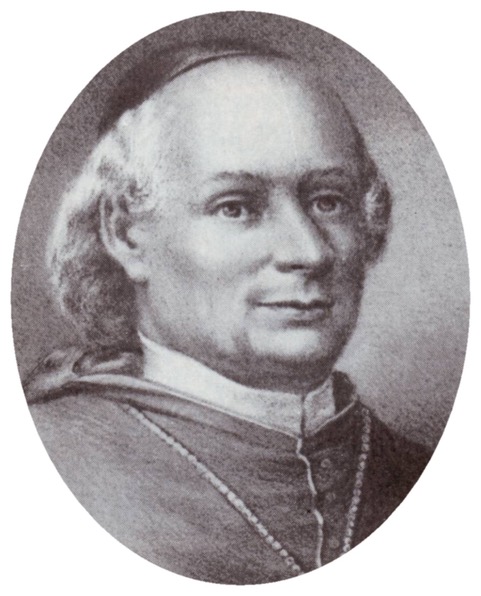
Cardinal Rinuccini, the papal nuncio, who came to Ireland in 1646.
When the war broke out in October 1641, Padre Luca actively encouraged Owen Roe O’Neill, a nephew of the Great Earl of Tyrone, to return home to take the lead of his Ulster compatriots. The Vatican funded O’Neill’s journey, providing him with a frigate, the St Francis, as well as a cargo of arms and munitions. In 1645, three years after O’Neill’s ship dropped anchor at Castledoe, Donegal, Wadding persuaded Innocent X, the new pope, to send his papal nuncio, Cardinal Rinuccini, to drum up support for the Catholic Confederate cause in Ireland. Indeed, Rinuccini was due to land in the Wadding stronghold of Waterford until his ship blew him westwards to Kenmare Bay on the south-west coast of Ireland. The Vatican also showed its support by dispatching 1000 braces of pistols, 4000 cartridge belts, 2000 swords, 500 muskets and 20,000 pounds of gunpowder; such a large consignment of enemy arms would be echoed with the dramatic landing of German guns and arms at Howth harbour on Dublin Bay in 1914.[19]
When O’Neill was victorious over enemy forces at Benburb, County Tyrone, in 1646, he sent the captured banners directly to Wadding who hung them triumphantly in the cupola of St Peter’s Basilica in the Vatican. Luke also nudged the pope into sending O’Neill the sword of his uncle, Lord Tyrone, which was a tremendous morale booster. As such, Luke’s spirit was profoundly crushed in the gloomy year of 1649 when O’Neill died of a mysterious disease eleven weeks after Oliver Cromwell arrived in Ireland to destroy the Confederacy. Father Richard Sinnott, a good friend of Padre Luca, was one of 29 Franciscan friars killed during Cromwell’s ensuing conquest.
At the peak of its power in 1644, the Supreme Council of the Catholic Confederation had written from Kilkenny to the dying Pope Urban VIII, and then to his successor, Innocent X, advocating that Wadding be made a cardinal. It was not until long after his death that his Franciscan brethren discovered that it was Luke himself who prevented such appeals from reaching the pope, preferring to retain a less exalted position. His contemporaries clearly wanted to lift him higher. In 1644, and again in 1655, he received votes as a candidate for the papacy, making him the closest Ireland has ever come to having a pope. In the wake of his death, there were even whispers of imminent canonisation.
Following his death in 1657, Luke Wadding was laid to rest in the college church at St Isidore. He would be survived by both his colleges, as well as thirty-six volumes of written work. [20] In the 1950s, his statue was erected on the Mall in Waterford; it now stands by the entrance to the town’s French Church. The library at the Waterford Institute of Technology was also named after him. In 2007, the archive of the General Curia of the Franciscan Order in Rome was likewise named in his honour.
A mural of St Patrick above his modest tomb recalls what was perhaps Luke Wadding’s most enduring legacy.[21] As a member of the Vatican’s Breviary reform commission of 1629, he entered St Patrick’s Day into the universal calendar of the Church as the feast day of the patron saint of Ireland. His old friend John Roche, now a bishop, clearly anticipated the long-term repercussions when he elated wrote to him, ‘God reward you for including his feast in the Roman calendar.’ 17th March is now arguably the best-known feast day of any saint on the planet.
Further Reading
- Keogh, Dáire & Albert McDonnell (eds), The Irish College, Rome and its World (Dublin: Four Courts Press, 2008)
- Binasco, Matteo. “Luke Waddingand Irish Diplomatic Activity in Seventeenth- Century Rome,” Studi Irlandesi: A Journal of Irish Studies 6 (2016): 193–203.
- Binasco, Matteo, ‘Luke Wadding, the Irish Franciscans, and Global Catholicism’ (Routledge, 2020)
Acknowledgments
With thanks to Maria O’Brien, Dr Niav Gallagher and Matteo Binasco.
End-Notes
[1] Rory’s older brother Red Hugh O’Donnell, who was chief of the clan from 1593 to 1602 died in the latter year near Valladolid in northern Spain, probably poisoned. It was thought his grave had been found in 2020 but excavations of graves now under a street showed no sign of him. Hiram Morgan told me in October 2022 that he may be under a nearby bank.
[2] I suspect the ancestors of Cardinal Merry del Val were also connected as they emigrated from Waterford to Seville in the early 17th century. Del Val was secretary of the papal conclave that elected the austere Pope Pius X in 1903. The new pope then appointed him Secretary of State, the oldest and most important department of the Holy See.
[3] It is said that Luke Wadding was educated by Peter White, the founder of what became Kilkenny College. However, Fr Ignatius Fennessy, who wrote Wadding’s biography for the ODNB, dismisses this claim reasoning that, as White was teaching in the c.1560s, this was too early to teach the young Luke. He suggests instead Mrs Jane Barden of Waterford, a Fr Dermot O’Callaghan and John Flahy. He also states that ‘Wadding himself said that his father watched over his Catholic training and education, and Harold recorded that Luke’s brother Matthew tutored him in elementary logic and physics.’ Benignus Millett, writing for the DIB, also names John Flahy. The Peter White assertion seems to derive from a book by Rev. P Power, Waterford Saints and Scholars (Waterford, 1920) (https://waterfordireland.tripod.com/peter_lombard.htm) but I know now how valid that source is.
[4] Dáire Keogh & Albert McDonnell (eds), The Irish College, Rome and its World (Dublin, 2008) pp14 – 23.
[5] The ODNB states that ‘He was given the name Francis in religion and sometimes used the title Luke of St Francis’
I have seen it said that Wadding was President of the Irish College of Salamanca, as well as its Master of Students and Professor of Divinity. I’m unsure if this is correct. Salamanca was one of six Irish colleges opened in Spanish Iberia during the reign of Elizabeth I to provide board and education for young Catholics, primarily Irish exiles, seeking to become priests. Once students were ordained, they generally went back to preach in Ireland. The others were at Santiago de Compostela, Seville, Madrid, Alcalá de Henares and, under Spanish rule at this time, Lisbon. The Irish College in Santiago de Compostello was founded in 1605 by the O’Sullivan family [Cork] and managed by the Jesuits from 1613. Its students studied philosophy for two years before graduating to the Irish college in Salamanca where they mastered Theology, before being ordained and travelling back to Ireland. The college in Santiago could host up to 16 students at one time.
[6] In 1618, Phillip III, the Spanish king, asked Antonio de Trejo, the Bishop of Cartagena, to lead a Spanish delegation to Rome to request that the pope define this devotion and Catholic dogma. The Bishop invited Luke Wadding to serve as both his theologian and secretary.
[7] The Franciscans were strongly associated with both the O’Neills of Tyrone and the O’Donnells of Donegal. Hugh Albert O’Donnell (1606-1642) was a mere baby when he was stowed upon the ship that sailed from Lough Swilly during the infamous Flight of the Earls. Wadding became friendly with young O’Donnell, the 2nd Earl of Tyrconnell, who promptly recommended him to the pope as a man of much ‘merit and talent’ who would make an excellent Bishop of Waterford.
His endorsement was not pursued but the teenage earl clearly had a good eye for promising and gifted clerics. During the 1610s, Hugh Albert O’Donnell resided at the Irish Franciscan College of St. Anthony’s in the Flemish Catholic stronghold of Leuven. Despite his youth, he did much to support the interests of his family and lobbied the Vatican to win benefices and promotions for Irish clergymen, especially Irish Franciscans. Tyrconnell kept onside with the Vatican when he came of age in 1625. In 1626 Pope Urban VIII wrote to Philip IV of Spain urging him to continue his support of his ‘dear friends’ O’Donnell and O’Neill who were suffering ‘the damages of poverty.’ It may be noted that since 1614, the government of Spanish Flanders paid 1000 crowns per month for the maintenance of O’Donnell and his entourage.
In 1627 Tyrconnell’s younger sister Mary Stuart O’Donnell, arrived in Brussels after having fled from London where Charles I had tried to make her marry a Protestant. The Pope warmly approved of her flight, blessed her ‘generous resolution’ and provided unspecified financial support.
From 1625 Tyrconnell put increasing pressure to have ecclesiasts from his circle appointed bishops in Ireland but all his efforts failed. I think his most promising protégé was Thaddeus Clery, a secular priest (and former Vicar of Down and Conor), who was educated at Salamanca and became chaplain Tyrconnell’s regiment in Flanders. Tyrconnell tried to get Clery appointed Bishop of Derry in 1631 but it didn’t pan out. I think Clery later became prior of St Patrick’s Purgatory, Loch Derg, and Vicar of Raphoe [Donegal]. He also backed Francis Tully, a lecturer at St Isidore’s in Rome for Bp of Killala in the early 1630s but it didn’t happen … the fact only one of Tyrconnell’s suggestions was taken indicates how the family influence has waned.
[8] Peter Lombard, Archbishop of Armagh and Primate of All-Ireland, stayed as a guest of the papa curia and hosted Irish students at his Roman residence in 1612.
[9] I think it stood on a street known today as Via degli Ibernesi.
[10] Irish pilgrims had been visiting Rome since at least the ninth century, including a number of Gaelic and Hiberno-Norse kings. The Annals of Innisfallen recorded a small community of Irish monks in Rome by 1095, while the Anglo-Normans were trading with Roman merchants in the twelfth century. In 1444, William O’Hedian, Bishop of Elphin (Roscommon), journeyed to Rome with a large entourage of clerics from Connacht and Ulster. The hospice was founded by John Swayne, archbishop of Armagh (1418-1439) who seems to have been in contact with Dietrich von Neem of the Vatican chancery. Between 1478 and 1522, at least twenty Irishmen joined the confraternity of Santo Spirito in Saxia, which was founded in 1478 by Pope Sixtus IV. No Irish were recorded on the great Roman census of 1527 but few of the 53,987 citizens’ backgrounds were recorded.
However, aside from that short-lived hospice, there was no notable Irish connections with the Italian capital. At the height of the Counter-Reformation – the kickback against the Protestants of Europe – just thirteen secular priests and two Jesuits from Ireland were ordained in Rome, while three Dominicans were recorded as having briefly lived in the city between 1572 and 1599.
The Irish presence in Rome gathered considerable steam in the early seventeenth century with the arrival of senior Gaelic nobles such as Hugh O’Neill and Rory O’Donnell after their comprehensive defeat by the English army in the Nine Years War. Stripped of their lands in Ireland, many of them settled permanently in the city.
Luke Wadding’s cousin the Waterford-born Archbishop Lombard died in Rome in 1625.
The 2nd Earl of Tyrconnell would later unsuccessfully push to have Fr Francis Tully, a Connaught-born lecturer at St Isidore’s in Rome, made Bishop of Killala.
Franciscan Hugh Ward (Aodh Buidhe Mac to Bhaird, Hugo Vardius, † 1635) was responsible for sending Leuven’s lay brother Michael O’Clery (Míchél Ó Cléirigh) to Ireland to transcribe as many of the extant ancient manuscripts as possible. Thanks to this ambitious undertaking, many valuable texts have been saved, as most of his remaining documents in Ireland have now disappeared. During his stay at the Franciscan Monastery of Donegal, O’Clery was also able to compile a martyrology from the manuscripts available to him under the title The Martyrology of Donegal even today in the Brussels Bibliothèque Royale.
[11] From 1655 until 1657 he was its vice-guardian.
[12] Hugh Albert O’Donnell to Fabrizio Veralli, Cardinal Protector of Ireland, Louvain, 7 October 1619, printed in Brendan Jennings (ed.), Wadding Papers, 1614-38, Dublin 1953, 19-20.
[13] John Roche (1584 –1636) was a Roman Catholic prelate who served as Bishop of Ferns (Wexford) from 1624 to 1636.
[14] The college constitution written up by Wadding.
[15] The death of Fr Eugene Callanan, the college rector, in 1629 precipitated a complicated dispute over the management of the Irish College that came before the Apostolic Tribunal of the Roman Rota, the supreme court of the Catholic church. In 1635, the court handed the college to the wealthier Jesuits who continued to run it, in conjunction with secular priests from Ireland, until an outbreak of student unrest in 1772 prompted a transfer of power to an Italian secular priest. With the French conquest of Rome in 1798, the College was closed for twenty-eight years. It was reopened in 1826 but at a new location.
“Having lost the property in Via degli Ibernesi to some Sisters, Pope Leo XII granted the Umbrian College to Father Michael Blake, a priest of the Archdiocese of Dublin, who came to Rome for the purpose of trying to re-establish the College.”
[16] Paul Cullen was from Narraghmore, County Kildare. At least twenty students from the Irish College returned to preach in Ireland during the seventeenth century. St Oliver Plunkett’s close friend Archbishop James Brennan of Cashel was at the college, as was James Cusack, who became Bishop of Meath in 1679. Also Bernard and Roch MacMahon who were successively both Bishop of Clogher (1727-37) and Archbishop of Armagh (1737-47). Numerous other bishops and priests of the seventeenth and eighteenth centuries also passed through its portals. Some troublemakers and ‘miscreants’ were kicked out of the college.
“Paul Cullen was the college rector for seventeen years, before going to Armagh as Archbishop and subsequently to Dublin as Archbishop and eventually as Ireland’s first Cardinal. He was succeeded by Tobias Kirby, a priest of the Diocese of Waterford and Lismore, who served as Rector for forty-one years from 1850 until he retired in 1891.”
“The early twentieth century saw the College under the care of two Rectors known for their nationalistic fervour, Michael O’Riordan from Limerick and John Hagan from Dublin. In 1926 Hagan decided to leave the site of the old College at the Church of St Agata dei Goti and move to its present site on the Via dei S.S. Quattro.”
[17] The success of the two Wadding colleges also inspired the Augustinians to establish a third Irish college in Rome in 1656. It petered out within five years but the Irish Dominicans were more successful when they founded their first college in the city in 1677. The Augustinians returned again in 1739 and ran a little-known Irish college that continued until 1798 when closed by the French.
Curiously the Irish population in 17th century Rome includes 26 Irish Protestants who converted. Between 1628 and 1800, at least 929 Irish clerics were ordained in Rome. The Irish College still educates students for the priesthood in Ireland, as well as postgraduate priests from around the world. There was a very controversial report on the college in 2014 by American cardinal Timothy Dolan.
[18] From 1630 to 1634, he was the Franciscan’s Procurator in Rome, and he served as their Vice Commissary from 1645 to 1648.
[19] Hutton, Annie; Aiazzi, Giuseppe, The embassy in Ireland of Monsignor G.B. Rinuccini, Archbishop of Fermo, in the years 1645-1649 (Dublin : A. Thom, 1873), p. x.
[20] Francis Harold, his nephew, wrote his life story. The learned Franciscan friar Bonaventura Baron was another nephew. The 36 surviving volumes of Luke’s own prodigious work include his history of the Franciscan Order and an edited version of the works of the 14th century theologian, Duns Scotus.
[21] Wadding’s portrait in oil is attributed to Jusepe Ribera after Carlo Maratti (who also supplied drawings for engravings), was subsequently acquired by the National Gallery of Ireland.