
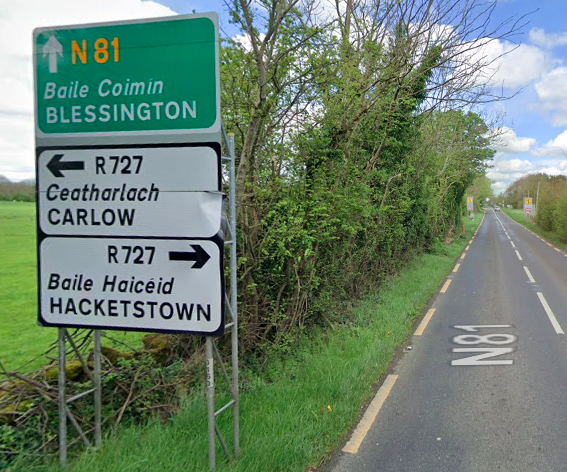
Approaching McGrath’s Cross in Tankardstown on the N81.
The County Carlow parish of Tankardstown (Baile Thancaird) is in the barony of Rathvilly, a little under 3km north-northwest of Tullow. It covers a chunky 1417 acres and borders the townlands of Ballybit Big, Rathlyon and Kilmagarvoge to the west, Knockeen and Liscolman to the east, Butlersgrange to the south and Tobinstown to the north. I believe Paulville is part of this same townland.
In 1824, an Abstract of Answers and Returns pursuant to Act for taking Account of Population of Ireland (HMSO), p. 5, reported:
‘In Tankardstown Parish it is observed, that the foundling children, of which there are many, are the chief support of the families who keep them; this and Tullowphelim Parishes, appear to constitute the Ecclesiastical Parish of Tullow.’
In his Topographical Dictionary of Ireland (1837), Samuel Lewis counted 1101 inhabitants, before adding:
“It is situated on the rivers Dereen and Slaney, the former of which separates it from the county of Wicklow and bounds it on the east, and the latter bounds it on the west. About 7/10 of its surface consists of meadow and pasture; the reminder is arable, with a small portion of wood. Within its limits are the small hamlet called from its situation Tankardstown Crossroads, and Cappagh House, the residence of William Young, Esq. In ecclesiastical concerns it is not known as a parish, but constitutes part of the rectory of Tullow, in the diocese of Leighlin; and in the Roman Catholic divisions also it is part of the union or district of Tullow. About 170 children are educated in two private schools. At Capnagh is the ruins of an old castle.”
According to the 1846 Parliamentary Gazetteer of Ireland, ‘the inhabitants of Tankardstown consisted of 42 Churchmen, and 1,059 Roman Catholics’ in 1834, while the ‘2 pay daily schools in Tankardstown had on their books 101 boys and 72 girls.’
The R627 crossroads in the north of Tankardstown is known as McGrath’s Cross Roads while the one to the north, where a minor road branches off towards Rathmore, is called Judy Lees Cross Roads. The hump of a bridge over which one drives when heading east towards Hacketstown from McGrath’s Cross is thought to be the only surviving railway bridge of the old Baltinglass to Tullow line. Tankardstown House, which stands between the cross and the railway bridge, was built, as a sign says, by James Doyle in 1969. Continuing over the railway bridge towards Hacketstown, the first crossroads you pass through offers you a slip road north (L60323) to Ballybit or south to Park House Stud. A roadworks sign erected at this cross in October 2025 maintained it was called Molly’s Cross.
I believe the actual crossroads of Tankardstown Cross is beside the entrance to Edward Byrne’s house. Edward is a building conservation consultant and founder of the Traditional Lime Company. His ancestors have been here since at least 1571 when a pardon was granted to James mac Gerald O’Byrne of Tankardstown, a horseman (cavalry soldier or knight). See here for more.
According to the Irish Ecclesiastical Record (Browne and Nolan, 1870), Volume 6, p. 245, ‘the ruins of an old church called Templemoneen – Teampull a Moinen’ were to be found just west of Tankardstown Cross and the Byrne’s house. (See here). Translated as “the church of the little bog”, it is described thus described in the Name Book: “Four or five head-stones in the graveyard, a portion of the west gable standing, about 9 feet high, and about 5 yards of the north side wall adjoining east gable, of about the same height , and covered with ivy. One stone has an inscription, dating to 1745.” (Comerford, p. 395), There is or was also a graveyard here. In 1603, the rectories of ‘Tankards town’ and ‘Templemoneen’ were part of a royal grant made to John Eustace of Harristown (and confirmed to his son Sir Maurice Eustace in 1627), which also included the rectories of Straboe (north of Tullow), Templeboy, Rathmore, ‘Moyacon (Clonegal), Donna honack and Ballaghmore (now part of Myshall).’
[Tankardstown is also cited by Breandán S. Mac Aodha in “An tAthrá in Áitainmneacha Na hÉireann.” Studia Hibernica, no. 24, 1988, pp. 122–26. I have not yet had an opportunity to look at the precise citation.]
Does anyone have any information on the Tankard family, sometimes Tancred, of County Carlow?
According to one definition:
‘Tancred or Tankred is a masculine given name of Teutonic or Germanic origin that comes from thank- (thought) and -rath (counsel), meaning “well-thought advice”. It was used in the High Middle Ages mainly by the Normans (French, Tancrède) and especially associated with the Hauteville family in Italy.’
There is a 2-metre high granite standing stone at Rathlyon in Tankardstown, known locally ‘Molly’s Cross Stone’, that appears to be aligned east-west with others in Tobinstown and Liscoleman. Rathlyon was home to the Healy family since 1826 but was sold recently and the Healys now live at Rathanure.
During the 19th century, a branch of the Doyles lived at Rathlyon House. The Pilot of 16 July 187 recorded how Eliza Doyle, daughter of Martin Doyle, joined the Brigidines in Tullow as per this account here. A generation later, the Pilot of 8 December 1900, here, recorded a marriage at the Church of St. Francis Xavier, Dublin, where the Rev. Daniel Rourke, cousin to the bride, assisted by the Very Rev. Monsignor Bourke, united in marriage Joseph M., eldest son of the late Martin Doyle, of Rathlyon House, Tullow, to Kate, youngest daughter of Thomas Maher, of Donore Houee, Bagenalstown.
There was a Brother Tancred who was involved with the Knights Templar who were themselves connected to Killerrig.
With thanks to Belinda Evangelista.