
See here for more stories from County Tyrone.

Woman at the Spinning Wheel
Rose Shaw was governess to the Gledstanes of Fardross House, near Clogher, County Tyrone, during the early decades of the 20th century. Her employers were Captain (later Lieutenant-Colonel) Ambrose Upton Gledstanes, 30th Lancers (Gordon’s Horse), an only son, and his wife, Isabella.
When not looking after the Gledstanes children, Rose spent much of her time walking in the Clogher Valley, photographing local people in the townland of Corleaghan, about 4 miles south of the village of Clogher, primarily members of the Holland, McElroy, McCaughey and Tierney families. Katrina and Sean Mccaughey of the Clogher Community Village Forum held an exhibition of the photos at Corick House Hotel in 2025.
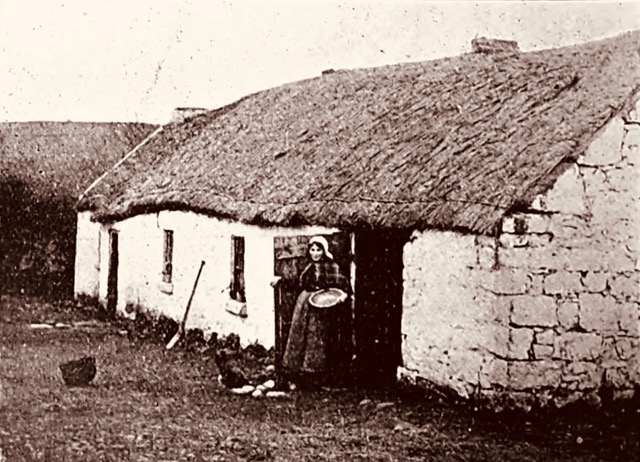
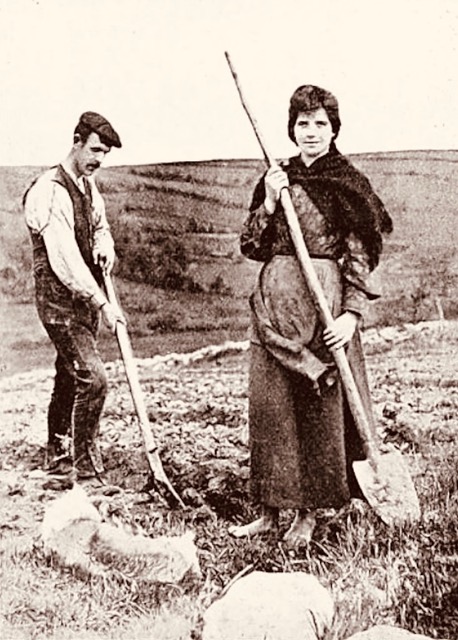
Rose developed her photos at Fardross in a windowless room off the dining room where the Gledstanes kept their silver. The 30 or so surviving images include a girl with a creel for collecting turf, people gathering sheaves of oats, smoking pipes, playing fiddles and melodeons, children walking to school barefoot, women clad in the traditional dress of a country labouring woman (ie: shawl, apron and skirt).
It all looks very charming and quaint but, of course, life for these people in poverty-stricken, tuberculosis-riddled Ireland was also brutal, harsh and, for children in particular, deadly.
Rose Shaw wrote ‘Carleton’s Country’ (Talbot Press, Dublin, 1930), with 16 “true-to-life” illustrations. The book focused on William Carleton (1794-1869), a controversial County Tyrone novelist whom William Butler Yeats described as “the best author that ever looked through Irish eyes”. It included an introduction by Sir Shane Leslie. In the book, Rose wrote:
“The homes of the people were warm and comfortable. A turf fire burns on the hearth and above it hangs the big iron pot full of potatoes or stirabout. The old bread-iron for toasting oat cake and the ‘tilly’ lamp have their places on the wall. In some houses the potatoes, when boiled, are turned out on a Hat home-made basket – a ‘scrahag’ – which is placed on a pail in the middle of the floor. The family sit around it on stools, each with a noggin of buttermilk in his hand to ‘kitchen’ the repast . . . In the long winter evenings the oats may be threshed with flails on the hard earthen floor of the house, or perhaps some of the neighbours may ‘happen in’ on their ‘kailyee’ (céili) and there will be fiddling and dancing and old songs and stories”.
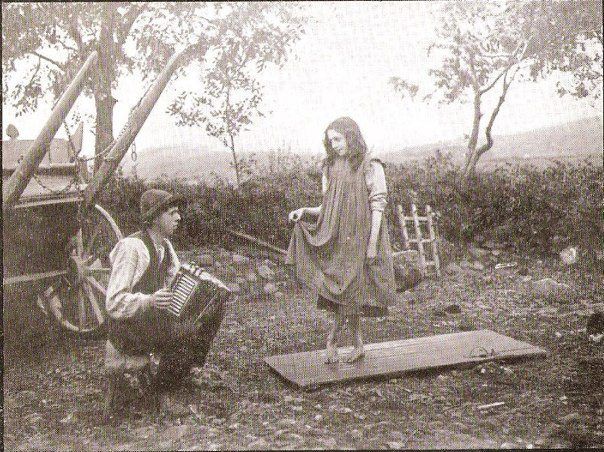
Dancing on the Door in Corleaghan, with Frank and Mini McGovern, grandfather and great-aunt of Josephine Treanor.
The chain migration from South Tyrone and North Monaghan to Providence, Rhode Island has been explored in much depth here by Ray McKenna of Federal Hill Irish. Ray’s ancestral farm was within six miles of Fardross, at Dernalosset, Errigal Truagh, Monaghan.
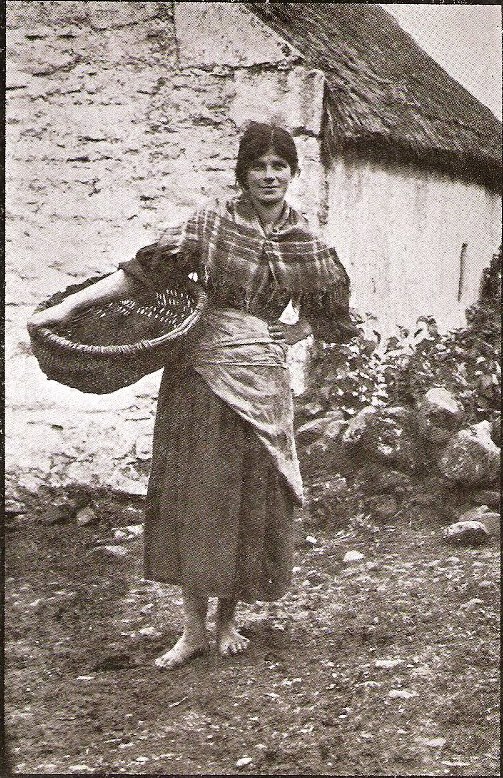
Woman & Basket
Born in 1876, Ambrose Upton Gledstanes was the only son of Captain Moutray Vance Gledstanes, JP, Royal Tyrone Fusiliers and 57th Regiment, and his wife Helen Catherine Verschoyle of Tassaggart, County Dublin.
Helen Catherine was a daughter of John James Verschoyle (1805-1891) and his wife Catherine Helen Foster (1822-1901), who descended from the Rev. W. Foster, Bishop of Clogher.
Helen Catherine’s brother was the Rev John Stuart Verschoyle (1854-1915),while she was a first cousin of the Rev. Hamilton Frederick Stuart Goold Verschoyle (1844-1932). The Rev. H.F.S. Goold Verschoyle lived for a time in Remo, as well as in Tunbridge Wells. One of these two clergymen is thought to have fathered William Nicholas Patrick Witton (1895-1949) by one of their servants. The boy was raised as an orphan. When he died, his casket was not placed in the ground in Birmingham (New Oscott) but moved to a secret family plot, as explained to me by his grandson Christopher Bradley in April 2024.
On 18 August 1909, Ambrose Gledstanes married Isabella Webber, eldest daughter of Major Robert Tankerville Webber, of Bryn Bellan, Mold, Flintshire, and his wife Isabella, daughter of the Hon. Rev. Willie Wingfield, Rector of Abbeyleix, County Laois, and kin of Viscount Powerscourt. (See the Webber section on the Colley page here.)
In 1956, Ambrose was involved in a car crash near Seskinore in which his younger sister Helen Margaret Gledstanes was tragically killed. (See below) His youngest sister Sophia Cecilia Marion Gledstanes (1880-1979) married Major Henry Foster McClintock (1871-1959) in 1930 and lived at the Red House, Ardee, County Louth.
****
Related to this clan was the Venerable Frederic-Falkiner Goold, M.A., of Rosbrien and Dromadda, Archbishop of Raphoe, who married Caroline Newcomen on June 16 1830.
So too was Ambrose Upton Gledstanes Bury (1869–1951) of Downings House, County Kildare who served as Mayor of Edmonton (1926–1929) and as Member of Parliament Edmonton East for seven years. (See here).
Cecilia, wife of Ambrose Upton Gledstanes, Esq., died at Fardross on 27 July 1861. (Irish American Weekly (New York), July 20, 1861, p. 3.)
****
Further Reading

‘Embracing Hope’ tells the story of the Irish farmers and labourers who, in the wake of the Great Hunger, made their home in the Ocean State. With the eye of a genealogist as well as an historian, Ray McKenna interweaves his family’s troubles and perseverance with those of their neighbours and friends. His depiction of their daily routines paints a picture of a way of life in the years before and during An Gorta Mór. Then, in nineteenth-century Providence, McKenna brings to life neighborhoods like Federal Hill, with its South Ulster flair.
‘Carleton’s Country – Rose Shaw, Review by G. P.’, The Irish Monthly, vol. 59, no. 695, 1931, pp. 332–33. See also the review in Country Life, 7 February 1931, p. 43.
My Irish Friends by Rose Shaw is referenced here.
There also seems to be a reference to a work called ‘An Irish Gamekeeper’ in Treasury Magazine: An Evangelical monthly for Pastor and People, here, or perhaps here. The magazine was edited by Anthony C. Deane, a son-in-law of Col. Versturme-Bunbury.
The Spectator (1914), v.112 here.
Acknowledgments
With thanks to Michael McClintock for sending me these fine photos. They were in an album captioned ‘My Irish Friends’.
Thanks also to Sylvia McClintock, Maria O’Brien, Marion Maxwell, Belinda Evangelina, Katrina Mccaughey and Josephine Treanor.

Barefoot to School
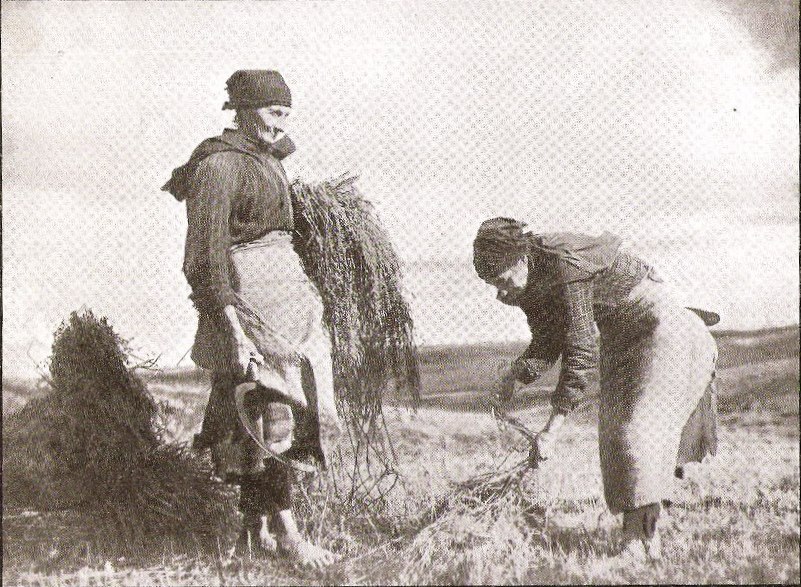
Barefoot Women with Sickles
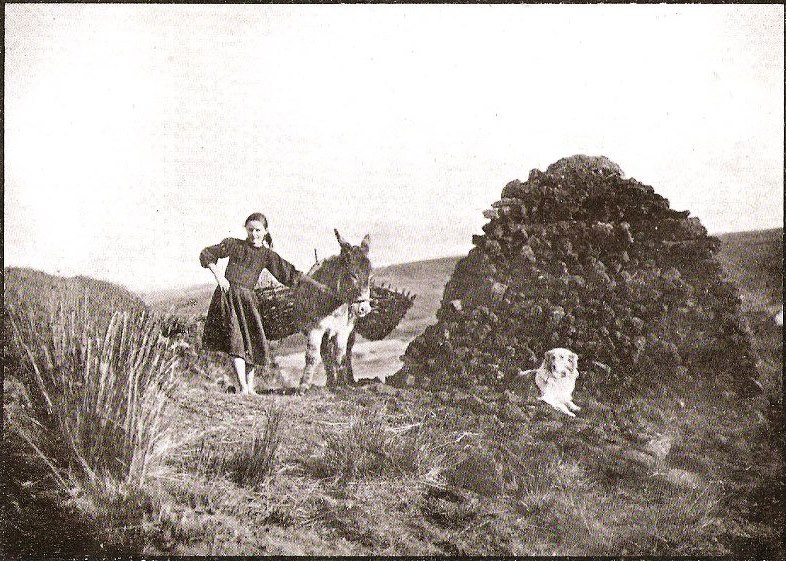
Collecting the Turf
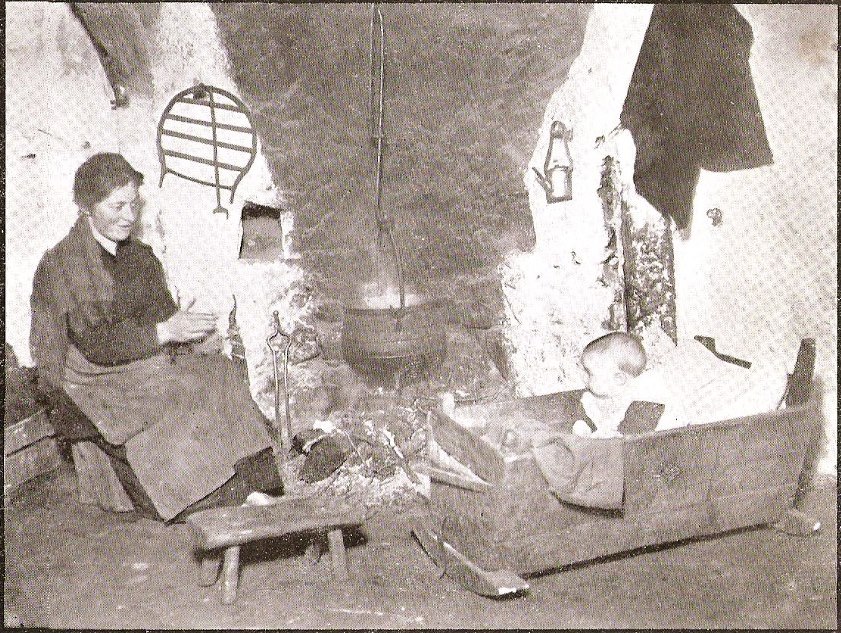
Cot by the Fire
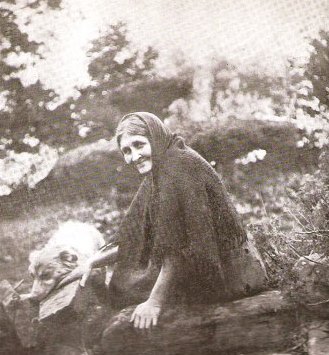
Woman & Dog

The Pipe Smoker: Cormac O’Halland, seanchaí and musician.
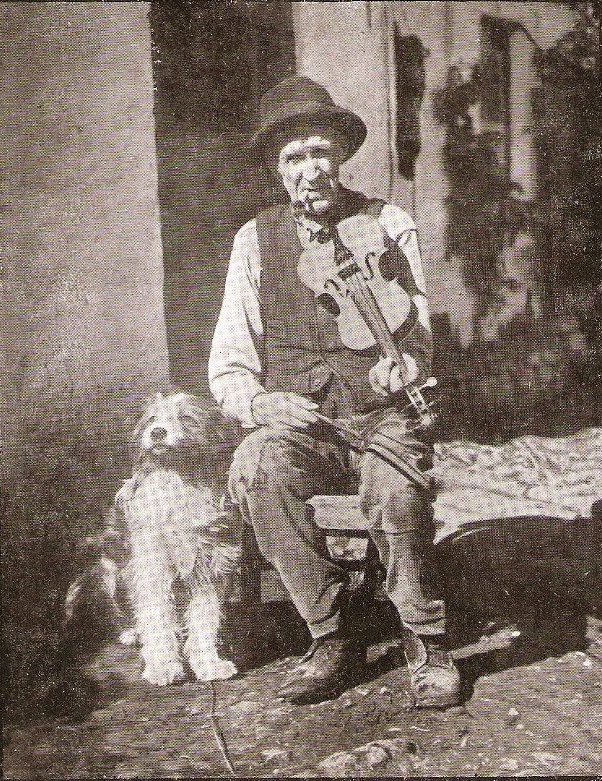
The Fiddler
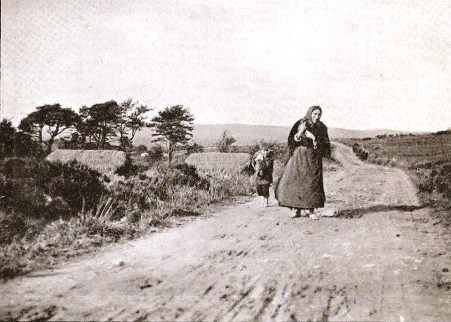
Mother & Child
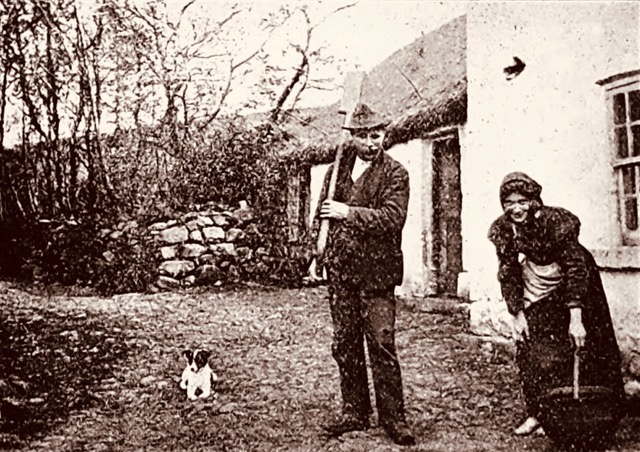

Rose Shaw’s signature inscribed on an original copy of her book which she gifted to Francis ‘Frank’ McGovern, the boy dancing on the door. With thanks to Josephine Treanor.

Londonderry Sentinel – Saturday 18 February 1956
Omagh jury exonerates Colonel from blame in death of sister, 81
An Omagh jury, at an inquest yesterday, exonerated Lieutenant-Colonel Ambrose Upton Gledstanes, Fardross, from all blame when they heard the evidence in connection with the death of his sister, Miss Helen Margaret Gledstanes, aged eighty-one, also of Fardross, and returned a verdict of accidental death.
George Neely said at 5.45 p.m. on February 7 he was driving on the Omagh to Clogher road when he heard the horn of a car being sounded continuously. As he walked back he saw Colonel Gledstanes standing beside his car which had gone through a hedge.
Colonel Gledstanes had blood flowing from his face, and his sister was in the car injured. Witness summoned help at once. Mr. A. J. Monteith, solicitor, said Colonel Gledstanes had not yet recovered from his injuries and could not attend, but he had no objection to the statement he made being read.
Head-Constable C. H. Rogers said on February 15 Colonel Gledstanes made a statement to the effect that he had been visiting friends on the Derry road, Omagh, and left for home about 4.55 p.m. His sister, Helen, was with him in the front seat, and after they passed through Seskinore, he overtook a red van travelling slowly. He pulled out to pass the van and saw a pile of dirt on the road. In order to avoid it he pulled over to the right and the car mounted the grass verge and entered a water channel. He tried to get it out but it ran into another water channel in the verge and went out of control. He applied the brakes but the car went through the hedge and stopped beside a dam.
He was unable to get out by the front door, and his sister did not speak. He managed to get into the back and out of the car. He tried to get his sister out hut did not succeed. With his sister he was taken to hospital, but he was not detained.
Dr. H. E. Packham. Tyrone County Hospital said Miss Gledstanes died from haemorrhage of the brain following a head injury. Mr. A. J. Monteith said although Colonel Gledstanes was seventy- nine years of age he possessed all his faculties. He had long experiernce as a driver, and was known as a careful driver. He asked the jury to exonerate him from blame.
Bath Links
Rose is said to have been from Bath. There was a Rose Shaw who made costumes for plays staged in Bath between 1921 and 1967, as per results here. The record here suggests she was linked to Stonar School. She died in 1949, aged 90. The daughter of a Wincanton farmer, her full name was Rosamund (or Rosoman) Lucy Maskelyne Shaw and she was born in Thatcham, Berkshire, the daughter of Bath-born Charles Shaw and his wife Annie. By the age of 21, she was living in Wincanton in 1860. When she organised various fundraisers in Wincanton in connection with the Irish Church Missions and the Famine Relief Fund in 1888 and 1889, Mrs. Shaw of West Hill was described as ‘a lady well known and much respected in the town.’ (Western Gazette, 7 September 1888, p. 7; Western Gazette, 12 April 1889, p. 7.) Her younger brother George Herbert Shaw (1861-1940) married Isabella Mary Bunter Shaw (1871-1939). Another brother was Charles John Shaw. See also here. Details of her family can be found here. Her obituary can be found in the Bath Chronicle and Weekly Gazette of 12 November 1949, p. 11. There is no mention of any writing. See her grave here.
Or could her line be from the booksellers and printers named Shaw whose tale is detailed below, with thanks to Belinda Evangelista.
Shaw’s – Printers and Booksellers of Dubin and Brighton
William Shaw, a printer and stationer, was based at 7 Bachelor’s Walk, Dublin, where, for instance, he printed The Connoisseur in 1827, and from where he wrote to the Chief Secretary’s Office in 1831.[1] He appears to have had a brother Lorenzo Shaw. [2] He was the father of George Ferdinand, Henry, Lorenzo (who died prior to c 1856) and Eliza. The Tyrrell family were closely related. [3]

‘Dublin has suffered a severe loss by the death of Dr. George Ferdinand Shaw, Senior Fellow of Trinity College, after a severe operation. Dr. Shaw, who was in his seventy-eighth year, entered Trinity College in 1839, and was elected a scholar in 1841. In 1848 he was made a Fellow, and in 1856 he took his LL.D. degree. He was co-opted a Senior Fellow and member of the Board in 1890, and until lately took a prominent part in the government of the University, in which he had filled almost every post of importance. For many years he was junior dean, and at the time of his death was senior dean. In the early sixties he took to journalism, and became a leader writer on the Nation. He was joint editor of the Irish Times during the first years of its existence, and about 1870 he became leader writer on the Evening Mail, his brilliant articles in that paper being well known. Dr. Shaw will be missed, not only in the University, of which he was an ornament, and in literary. circles where his abilities and his wit were highly appreciated, but also in Dublin society, in which he was much respected and very popular – Our portrait is by Chancellor, Dublin.’
Graphic – Saturday 24 June 1899, p. 9.Graphic – Saturday 24 June 1899, p. 9.
Dr George Ferdinand Shaw (1821-1899), a famous master at Trinity College Dublin where he was Registrar and Regius Professor of Greek and Professor of Latin. He was also first editor of the Irish Times before he handed over the position to his brother-in-law and fellow Trinity Fellow Rev. George Bomford Wheeler (1805-1877), who married his sister Eliza Shaw. In 1853, Dr Shaw married Anne Ellen Shinkwin, daughter of John Shinkwin, Esq., of Montpellier Hill, Dublin. They later divorced, having had sons George F Shaw, twin sons Townsend Shaw and Stanley Shaw (born 27 April 1859), another son born 27 April 1865, according to the Cork Examiner) and a daughter Maud Shaw (1863-1950) who married a Robert Clarke. (See here) Dr Shaw died at Portobello House, Dublin, on 19 June 1899. This was an asylum for the blind so perhaps, like his nephew William Bury Shaw, he had gone blind. Administration of his will was granted to Constance Shaw of 63 Upper Leeson Street, Dublin.[4] One of his sons was District Inspector of Roscrea, County Tipperary, by 1899.[5]
Henry Shaw, printer, took over the Ormond printing works but was at some stage bankrupted. He was the proprietor of the Commercial Journal and Family Herald. In 1850, he issued the “New City Pictorial Directory” of Dublin, illustrated with many beautiful wood-engravings in outline of the principal “business” streets. “A particular feature of these pictures was the engraving of the names on the shop front, or above the house, of such occupiers as paid for this very effective ad. For instance, 7 Sackville Street was the tailoring establishment of Kohler who made the gorgeous green and gold uniform of the 1782 Club for The Liberator, his brother, and Charles Bianconi and others.” The Pictorial Directory only appeared once, probably because of the significant costs. At the time, he was based at 40 Lower Ormond Quay, Dublin. He was still there on 5 March 1861 when his wife Catherine Shaw gave birth to their youngest son, Leonard Barrett Shaw. No. 40 was later home of the I.B.L. They later moved to Lewisham, Kent.
Henry and Catherine had several sons, ‘a band of brothers who were all connected with printing and allied trades.’
Henry’s son William Bury Shaw was born in Dublin in 1845. When he was in his 20s he moved, via London, to Brighton where he became a well-known bookseller and stationer at 206 Western Road from about 1868. (‘He was the first in that town to start the discount system of selling books and magazines.’) He also opened a toyshop at 208 Western Road in 1870. He was living in Brighton at the time of the 1871 census with his wife Matilda and their one-year-old twins, William H Shaw and Lilian R Shaw, known as Rose, born in 1872. A prominent Freemason, he served as a member of Brighton Town Council from 1886 to 1892 when he lost his sight, although, according to his obituary in Bookseller (1 January 1921, p. 17), ‘he conquered this handicap with courage and a high fortitude that drew the admiration of everybody who knew him. His blindness forced him to give up his connection with municipal work, in which he had taken a keen interest.’ Matilda died at Grenville House, Clarence Street, Brighton, on 15 March 1919, aged 75.[6] He was in failing health for some time before his death at his Brighton residence aged 76 on the morning of St Stephen’s Day December 1920. [7] The last surviving brother, he was buried at the Extra Mural Cemetery, Brighton. His eldest son William had by then taken on the bookselling business while Rose Shaw was running the toyshop. His second son Reeves Shaw was editor of several successful publications of Messrs. George Newnes in London while the younger son, Herbert Shaw, was ‘known as a writer of stories for the popular papers.’
In 1935, Strand editor Reeves Shaw paid Churchill £250 for an article called ‘The Truth about Hitler,’ published in The Strand Magazine of November 1935. He asked Churchill to make it “as outspoken as you possibly can… absolutely frank in your judgment of [Hitler’s] methods.”
Henry’s son Leonard Barrett Shaw (1861-1914) was living with his older brother William Bury Shaw at Brighton, Sussex, at the time of the 1871 census. He was married on 1 August 1887 at St. Stephen’s, Lewisham, to Ada Elizabeth, eldest daughter of the Robert Brown Shaw (1842-) and his wife, a daughter of Mrs Mourgue of Bow and Clerkenwell.[8] Leonard ran Shaw & Sons, a printing company, at 105, Loampit-vale, Lewisham but the poor fellow became bankrupt in 1913 (here) and killed himself with ammonia (here). His daughter Maud Helen Shaw (1890-1976) married William King Swan (1882-1947) and settled in Calgary, Alberta, Canada. Leonard and Ada also had a son Leonard William Shaw (1894-1951).
- The pioneering Birmingham photographer George Shaw (1818-1904), see here.
- Rosoman L M Shaw listed as a teacher 1891 Census and in 1911 Census, with two servants, occupation private means?
- Alice Edith Shaw married Reverend John Brass (1839-1912), the Curate of St Saviour’s Church, Eastbourne. Their son Cyril Herbert Brass was born on 7 January 1872. See photo history here.
End-Notes
[2] Saunders’s News-Letter – Saturday 28 May 1836, p. 2.
[3] See here for Tyrrell links, eg Reginald B. Tyrrell, T.Y. Tyrrell and R. L. Tyrrell.
[5] Midland Tribune – Saturday 24 June 1899, p. 6.
[6] Mid Sussex Times – Tuesday 18 March 1919, p. 5.
[7] Mid Sussex Times – Tuesday 04 January 1921, p. 5.
[8] South London Press, 13 August 1887, p. 15.