

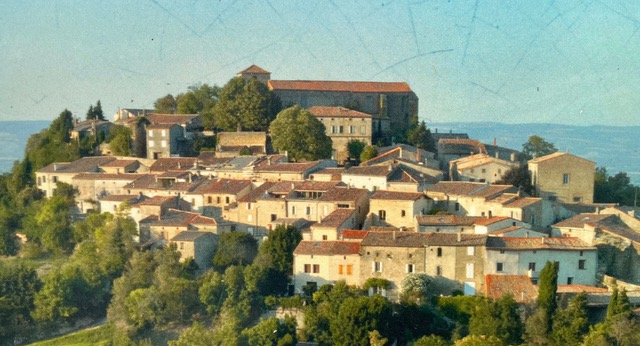
Laurac-le-Grand
Between 1209 and 1230, the Roman Catholic church orchestrated a crusade into southern France to exterminate a renegade Christian belief system known as Catharism or the Albigensian heresy. Approximately one million people are said to have died in the war.
I first came across this astonishing business when I read ‘Holy Blood, Holy Grail,’ the mother of all conspiracy books, in which the authors propose that Jesus and Mary Magdalene had children, who subsequently intermarried with the Merovingian dynasty, protecting the secret of their sacred lineage through societies such as the Priory of Sion.
Tosh and nonsense for the most part, but it certainly made me think. It also introduced me to the deeply compelling world of the Merovingians and Carolingians.
And the Albigensian Crusade too.
Modern Minds

Laurac-le-Grand, entrée du village (Archives départementales de l’Aude)
At first glance, the Cathars seem like very modern minded Christians. Women were equal citizens, albeit spiritually. [1a] Mingled easily with Jew and Muslim. Pacifists. Vegetarians, too. Yes, I think I’d have had a few Cathar friends although I’m not sure I could have handled their celibacy, let alone chastity, and there’s too much misery in their austerity. However, I can see why they might have viewed the world itself as a globe of psychotic madness created by an inherently evil Satan, aka Rex Mundi. To this end, they developed their own form of spiritual baptism, a laying on of hands that purified the soul, enabling them break free of the cycle of hell and to be reincarnated as free souls.
This dualistic worldview of two equal and opposing divine principles—one good (God) and one evil (Satan) – originated with the Bogomil movement in Bulgaria before the year 1000, named after the priest Bogomil who espoused this dualist theology. Bogomilism itself was influenced by the Paulicians, a dualist Christian sect originating in Armenia and the Middle East. These ideas migrated through Serbia and into northern Italy and Germany, reaching Cologne in the 1140s. It then spread like wildfire down through the Rhineland into southern France, taking root in a part of Occitania, or Languedoc, bound by lines connecting the cities of Toulouse, Albi, Carcassonne, and Foix. [1b]
 In May 1167, the same year that Anglo-Norman mercenaries began gearing up to invade Ireland from Wales, the Cathar community was formalised at the Synod of Saint-Félix (now Saint-Félix-Lauragais), and organized itself into three bishoprics: Agen, Carcassonne, and Toulouse. Nicetas, a Bogomil bishop from Constantinople, was among those in attendance.
Fatally, the Cathars rejected the authority of the Catholic Church and its sacraments. The papacy had zero tolerance for such independent mindsets and deemed the Cathars dualist mindset heretical. St Bernard of Clairvaux – friend and biographer of St Malachy, founder of Mellifont Abbey in Ireland – pronounced a curse against them in 1145.
The Cathars of Lauragais
There were some concentred ‘pockets of heresy’ around Béziers, to the east, and in the Pays de Sault (Nioth country) of the Pyrenees, to the south, and in the northwest, around Agen. However, in terms of the Toulouse-Carcassonne axis, the principal hotspot for the Cathars was the plain called the Lauragais, home to the fortified towns (castrum) of Laurac, Montréal, and Fanjeaux. Almost all of the knightly families of the Lauragais had become Cathar enthusiasts, admitting Cathars and Waldenses to their households and allowing them to preach freely in their domains.
Laurac-le-Grand is a gloriously tranquil village set within a bowl of hills that I was lucky enough to cycle up (and screechily free-wheel down) while staying with the Jelletts in the village in July 2025. The roadsides were lined with almond and plum trees, the road itself devoid of traffic. On that bike ride, we were rewarded with marvellous views of the Massif Central and the Pyrenees. A signpost assured us that, if we looked closely, we could even see the old roads leading to the Levant and to the Atlantic coast. We beheld the La Salle estate, given by the Laurac family to the Knights Hospitaller.

Located in a field about 2km out of Laurac on the road to Villasavary, here, this innocuous mound was once the House of Laurac’s military outpost of Queille.
La Salle came under the remit of the Laurac’s increasingly fortified military outpost at Besplas. This was one of at least three satellite castles, all pitched on earthen mounds, that were located within a one kilometre radius of the present-day commune of Laurac. These castles enabled the lords of Laurac to command, protect, and monitor the area.
The two other castles were located at Pech-Redon and Queille. There’s no remains of these castles now; their wooden towers were probably lost to the flames in the 13th century, but Queille still presents itself as the very motte-looking place pictured opposite.
Lady Guiraude de Laurac had become the lady of Lavaur upon her widowhood. She and her brother Aymeric de Montréal, a giant of a man, led the resistance to the crusaders in Laurac-le-Grand. They were the children of Sicard de Laurac and his wife Blanche de Paracols. Sicard descended from Guilhabert de Laurac, the first seigneur of Laurac. An influential vassal of the House of Carcassonne, Guilhabert built the first castle in Laurac in 1063. The town then gave its name to the entire region of Lauragais. [2]

The legacy of the Knights Hospitallers is found in a street name in Laurac. A tourist board told me the Laurac family gave them the La Salle estate circa 1130, so quite early in the Hospitaller’s history. They then built the Romanesque church of Saint-Martin here, likely on the site of an earlier church of which all records are lost.
After Sicard’s death, Blanche became a zealous Cathar and raised their five children likewise. Based at Laurac-le-Grand, her son Aymeric de Montréal was the heir to both the Laurac and Rocquefort-Montréal estates. Aymeric was the vassal of Raimond Roger Trencavel, viscount of Carcassonne and Béziers, who himself was a vassal of the Count of Toulouse. Aymeric was also the richest vassal in Trenceval.
As Guillaume de Tudèle put it in the ‘Song of the Albigensian Crusade’:
“There was neither in Toulouse nor in the rest of the County of Toulouse a knight richer than you, nor more generous in his spending, nor of greater nobility”
In 1207, Aymeric helped organise a major theological debate between Catholics and Cathars, which was attended by the highest moral authorities from both sides, including Dominic de Guzmán (the future St Dominic) and the Cathar bishop Guilhabert de Castres.
For the French king Philip Augustus (1165–1223), the problem was that Aymeric de Montréal was too rich, and too powerful. That was one reason why an a crusading army was assembled by the arch-see-you-next-Tuesday by name of Simon de Montfort.
Backed by Philip Augustus and by Pope Innocent III, his mission was not just to crush the Cathar but also to dismantle this ambitious feudal seigneury.
The Crusade Begins

Simon de Montfort (1175–1218), a 17th-century representation.
The catalyst for war came in January 1208 with the assassination of the pope’s legate, Pierre de Castelnau. In June 1209, the pope launched his crusade against the ‘heretics’ (the Albigensians) and all who protected them. It was the first time a crusade had been directed at Christians within Western Europe.
The viciousness of de Montfort’s campaign became apparent early on with the massacre at 20,000 people at Béziers. (“Kill them all, and let God sort them out” was seemingly the order.) Carcassonne fell at the end of August, followed by Fanjeaux, which became de Montfort’s headquarters.
Next came Bram, where do Montfort had the local priest dragged through the streets by a horse before executing him. He also assembled a hundred prisoners and had their eyes gouged out and noses cut off. The desecrated captives were then forced to walk to the fortress of Cabaret, a Cathar stronghold at the heart of the Montagne Noire, being led by a prisoner who had been spared total blindness and blinded in just one eye so that he could guide them.
After an alliance with Peter II of Aragon failed, Aymeric de Montréal’s options were limited. When de Montfort’s crusaders arrived at Laurac, he paid homage. But when Montfort went to attack Lavaur, Aymeric went to the defence of his sister, Lady Guiraude.
It all ended tragically on 3 May 1211 when Aymeric was defeated in battle and hanged. The scaffolding collapsed beneath his weight, having slashed him across the throat, and it had to be rebuilt in order to finish the job. Meanwhile, eighty of his knights were massacred. Lady Guiraude was also captured by de Montfort’s men and hurled into a well in Lavaur, after which they threw stones on top of her until they could hear her screams no more. That said, I have read that this gory story is fictitious. A lot of this information seems to be from a book called ‘History of the Heresy of the Albigensians and the Holy War Undertaken Against Them’ by Pierre de Vaulx-Cernay. It is also in ‘Song of the Albigensian Crusade’ (La Canso) by Guillaume de Tudèle.
Laurac-le-Grand

Artist’s impression of the original fortress at Laurac.
As I read up in the crusade, and walked through the narrow streets and alleys of Laurac, I had a strong sense of another world that has been wiped out, that died with the howls in the dungeons and wells beneath my feet. The Cathars believed this world is hell and that turned out to be a horribly precise divination for many of them. They were literally eradicated. It’s like how the entire population of Gozo were carried into slavery in the 1540s, creating a year zero for the island. The Lauragais had to start again in the early 13th century.
You still access the village of Laurac-le-Grand itself by walking through the remnants of its extraordinarily thick medieval Saliège Gate, where a drawbridge was once raised and lowered. (A second gate, called la porte Riane is gone). La Porte Saliège was pivotal when Laurac was a Cathar stronghold.
Hugo walked me all the way up to the highest point of the village. This was once a large motte here, about 40 meters in diameter, with Guilhabert’s seigniorial castle atop. The castle was torn down in 1229, under the terms of the Treaty of Meaux and I don’t see much evidence of it now, save that a ring of houses just below it seemingly corresponds to a defensive ditch built back in the way backs. Today, the high point is simply a viewing platform, and they do those platforms very well in these parts, with a fine statue of Jesus on the cross nearby.
Gone too is any hint of the druidic world that must have been here before the Romans came, with Julius Ceasar leading the first of two genocides this region has suffered. I suspect that, as in Ireland, most churches were built on sites that were previously dedicated to other gods. From the viewing platform in Laurac, one can see the spire of Fanjeaux. It transpires the name derives from fanum jovis meaning ‘temple of Jupiter’. Over a thousand years after the Romans, de Montfort saddled up for the Albigensian Crusade.
Not far from the Jesus statue is the old church of Saint-Laurent, being tarted up and re-rendered while I was there. A little lower down was the old boules court. They moved the boules (petanque) court to a more out of town place a few years ago; we visited it and found it abandoned with the French equivalent of tumbleweed blowing back and forth.
Hugh de Lacy, Lord of Laurac

Francois and Zachary very kindly lay on the Hugh de Lacy exhibition for me in Laurac, July 2025.
During my visit to Laurac, we were invited to drinks in the town hall where a kind man relived me of €20 and gave me a bunch of toy coins which I then converted into beers and wine spritzers for all. Our group has been swelled by the addition of neighbours from the village, including an English lady who fled England in the early 1970s. Somehow or other I was singled out as a historian and directed to meet a man named Francois Steenkeste who was also of a historical bent. He spoke as little English as I do French but, next thing I knew, Francoishad magicked up a panel explaining how Hugh de Lacy, Earl of Ulster, joined de Montfort’s dreadful crusade in 1209 and became, for at least nine years, the lord, or seigneur, of Laurac and nearby Castelnaudary.
Two days later, I returned to the town hall where Francois and his friend Zachary had reconstructed the entire exposition on de Lacy. It turns out this was the brainchild of Paul Duffy, an archaeologist with whom I had consulted for one of my Past Tracks panels, who is also a biographer of the said Hugh de Lacy. He had even sent me a copy of his novel ‘Run With the Hare, Hunt With the Hound’ about de Lacy’s early years. As well as organising expositions and symposiums, penning novels and overseeing archaeological digs, Paul has made a lot of his material available via his Academia page: https://leicester.academia.edu/PaulDuffy Needless to say, I renewed contact with him after my Laurac adventure.
I knew a bit about Hugh de Lacy before I arrived in Laurac. His grandfather Gilbert was a prominent Knight Templar in the Holy Land, while his father, also Hugh, was a remarkable castle builder in Ireland, with Trim Castle (Ireland’s oldest stone castle) and Kilkea Castle among his legacies. Hugh himself would marry one of the de Ridelesford heiresses of Kilkea Castle in later life. I also knew he fell out with King John, and fled to France, but I had failed to note how he subsequently became one of Simon de Montfort’s sidekicks in the Albigensian Crusade.

Map showing Laurac in relation to Carcassonne.
According to the Book of Howth, Hugh abandoned his Ulster castle at Carrickfergus in the face of King John’s army and made his way, via Scotland, to Normandy. He initially went into exile at the Benedictine monastery of St Taurin in Évreux (dep. Eure), having disguised himself as a peasant because King John’s spies were in the hunt for him. In 1200, Hugh’s Trim-based brother Gautier de Lacy, Lord of Meath, gifted Fore Abbey in Westmeath to the monks of Évreux, so this stacks up, not least as For Abbey is likewise dedicated to St Taurin. While in Évreux, he likely hooked up with Philippe Augustus (who abhorred King John) and de Montfort who were by then planning their crusade.
Ever the opportunist, the exiled Earl of Ulster joined the crusading army in 1210. At that time, the Cathar defence was led by Raymond VI of Toulouse (1156–1222). When Raymond whittled de Montfort’s army down to 500 men in the summer of 1211, Hugh was among the knights who remained loyal to the crusader. De Montfort was by then ensconced at Castelnaudary. When Raymond’s forces besieged the garrison, they built a perrière machine on the Pech Hill (la colline du Moulin de Cugarel) to catapult stones at the castle walls. However, the local Lauragais stone was so soft and brittle that it broke upon impact, proving all but useless as a siege weapon.
According to the Chanson (Song of the Albigensian Crusade), Hugh fought at the Siege of Beaucaire in 1216 and at the Siege of Toulouse in 1217-1218. In fact, the crusaders participated in at least 45 sieges but fought only four field battles between 1209 and 1218. One of these was the battle of Saint-Martin-la-Lande in 1218 in which Hugh probably took part in a victorious charge by the crusaders.
Laurac and Castelnaudary were his rewards. He held both estates lands from 1212 until at least 1221. During that time, he granted three lots of land to Dominic de Guzmán, the future St Dominic, founder of the Dominicans, whose monastery at Prouille was a huge Gothic fortress surrounded by a wide moat. Dominic also founded his first house of nuns at Fanjeaux. Hugh granted a fourth lot to the Order of Saint John of Jerusalem in Toulouse.
That said, I gather he did not fully adhere to his orders, allowing some Cathar sympathizers (“bonnes femmes”) to live and train others in their beliefs in Castelnaudary.
I mused on all this when Jemima and I boarded a Carcassonne-bound train in Castelnaudary on a quiet Monday morning, shortly after I had enjoyed coffee in Le Bar de La Gare with Tom Sykes, Johnny Sykes and young Thomas Monaghan. I could not get much sense of medieval sieges about the 21st century Castelnaudary that I saw. It seems to be an industrial town through and through.
De Lacy’s Exit

Jumping for Jupiter on the streets of Fanjeaux, July 2025.
In 1215, Simon de Montfort hosted Prince Louis of France (the future King Louis VIII) at Fanjeaux before accompanying him on a formal entry into Toulouse. Three summers later, on 25 June 1218, a mangonel catapult operated by women scored fired a large rock that landed a fatal blow on de Montfort’s head.
Shortly afterwards, Raymond VII (1197-1249), the young Count of Toulouse (a grandson of Henry II of England), launched a counter-offensive, retaking Laurac, Fanjeaux, and Bram. He also captured Hugh’s principal base at Castelnaudary.
Hugh may have fought under Amaury de Montfort, Simon’s son and heir, who attempted to wrestle back control of Castelnaudary with a major siege between July 1220 and March 1221.With the failure of that siege, the landless Hugh de Lacy upped and split back to Ireland.
By 1227, he had regained the earldom of Ulster, making good use of the siege tactics and other military innovations that he had mastered under do Montfort. The first record of siege machines in Ireland appears in an account of Hugh’s siege of Lough Cé in County Roscommon and included siege towers and other engines.
The De Niort Family

Equestrian seal of Bernard Othon of Niort attached to a document in which the lord of Laurac and his brothers declare that they place their castle of Laurac at the disposal of the King of France, c. 1226.
Raymond was a fine warrior, but he was no friend of the Cathars either. Many of those that he captured were burned alive. Fortunately the Cathars found new protectors in the form of the de Niort family.
Aymeric and his sister were long dead, but their sister Escalrmonde survived. She had married Guillaume de Niort, Lord of the Pays de Sault. Their son Bernard Othon de Niort seized the lordship of Bram and Montréal after its previous lord, the de Montmorency ally Alain de Roucy was fatally shot by a crossbow bolt. A friend of Cathars, Bernard ushered in a new golden age for them, free from persecution, while the Niort family and other local nobles and knights did the same in Laurac.
Following the entry of Louis VIII of France into the Crusade in 1226, the Lauragais nobility gradually switched allegiance to the Capetian sovereign. Bernard, the grandson of Blanche de Laurac and heir to the lordship of Laurac, submitted to the king. He continued to protected Cathar ‘heretics’ and ousted Raymond’s cronies when they sought to arrest them. When a French knight captured a Cathar medic who had helped cure Bernard, the knight was ambushed and slain.
With the Treaty of Meaux in 1229, Languedoc lost its status as an autonomous region between Aragon and France, and became part of the kingdom of France. Members of the Niort family quarrelled with the Archbishop of Narbonne over property rights and raided his lands in 1232, wounding the archbishop. For such antics, the Niorts were condemned as heretics by Pope Gregory IX, while an Inquisition dispossessed Bernard of his properties in Lauragais. These passed directly to the French king’s vassal, Raymond VII, Count of Toulouse.
Aftermath

Memorial to Georges Roby, who was shot dead in 1944.
In the 15th century, King Louis XI granted the Lauragais to Cardinal Bernard de la Tour after the holy man ceded him his counties of Auvergne and Boulogne. The cardinal elevated it to a county and the Lauragais region then became a jugerie (a judicial district) dependent on the seneschalcy of Toulouse.
A century later, it passed to Catherine de Medici – regent of the kingdom and mother of three kings – who had Laurac elevated to the status of the seat of a royal seneschalship. A seneschal was installed the following year. The Laurac place names “Pech de Malemort” (Hill of Bad Death) and “Rec de Marosang” (Stream of Bloody Death) apparently link to a local memory tied to violence unleashed by the St Bartholomew’s Day massacre in 1572.
I didn’t really get much sense of what happened in Laurac in the Revolution or the 19th century. There was a memorial to all the poor sods who died in the Great War. When we reached Pierre Plantée on our bike ride, we espied a monument to Georges Roby, a French resistance partisan who was shot dead here on 7 August 1944.
A woman named Anne-Marie, a fifth generation farmer, told me that when she was young all the fields around were full of cattle and sheep but there’s only one young lady farmer with livestock these days. I loved wending in and around the slender lanes of this enchanting town of pale la vieille pierre (old stone) houses, roofed with red and orange cupped terracotta barrel tiles, all mish-mashed together beneath the ridge of the green, semi-forested slopes of the Collines Cathares (Cathar Hills) – part of the Massif de la Malepère, perhaps? – where Sasha and Roz and I walked through a pine forest early on a Saturday morning.
The population of Laurac-de-Grand has not shifted much in recent years, with an average age of sixty something. There are streets named l’ecole, l’hôpital and le boulangie, but there is no school, no hospital, no bakery. When I heard a baby cry, I was told that was the first baby born in Laurac in almost a decade. It is a beautiful village, even with that medieval horror in its DNA. I much look forward to returning soon.
With thanks to Francois Steenkeste, Hugo Jellett, Roz Jellett and Paul Duffy.
Further Reading

A street in Laurac, July 2025.
- Baigent, Michael, Richard Leigh, and Henry Lincoln. Holy Blood, Holy Grail. New York: Delacorte Press, 2004.
- De Vaulx-Cernay, Pierre The History of the Albigensian Crusade. Translated by W.A. Sibly and M.D. Sibly. Woodbridge: Boydell Press, 1998.
- Duffy, Paul, Tadhg O’Keeffe, and Jean-Michel Picard, eds. From Carrickfergus to Carcassonne: The Epic Deeds of Hugh de Lacy during the Albigensian Crusade. Brepols, 2018. ISBN 978-2-503-56781-5. See here for full the full contents of this bi-lingual symposium.
- Duffy, Paul. Ireland and the Crusades. Four Courts Press, 2021.
- Duffy, Paul M. Run with the Hare, Hunt with the Hound. Cennan Books, 2022
- Duffy, Paul. 2014 Ung Sage et Valent Home – Hugh de Lacy and the Albigensian Crusade. Journal of the Royal Society of Antiquaries of Ireland 141 (2011), 66–90.
- grassrootsarchaeology.ie
- paulduffywritings.com
- Duncan Taylor, Colin, ‘Lauragais: Steeped in History, Soaked in Blood’ (Troubador Publishing Ltd’, 2018)
- Poudou, Francis, author. Opération Vilatges al Pais: Canton de Fanjeaux. Narbonne: Communauté de Communes de la Piège et du Lauragais, 2008.
End-Notes
[1a] The equality between the sexes was fundamentally a spiritual thing. Women could become “Perfects” (also called “Good Women”), by which they lived a consecrated life, preached, and administered sacraments such as the consolamentum. However, in practice, men continued to exercise more power and outside those religious roles, Good Women were given more sedentary tasks like educating novices and caring for the sick. They also traveled much less than men due to safety concerns in the violent medieval context, and sometimes ate apart from the fellows. Also, I’ve no doubt some 21st century souls would approve of how the Cathar faith not only rejected the Catholic concept of original sin and the idea that women were inherently temptresses, but believed that souls were not gendered and that the distinction between men and women was a creation of the Devil affecting only the body.
[1b] My friend John Power tells me there is a fabulous trek that goes through the Cathar castles at Monsegur, Bugarach, Peryepetreuse and on into Spain that is like ‘a journey back in time.’
[2] I wondered whether laurac might stem from laura, meaning a cluster of hermit cells and monastic passageways, particularly in Eastern Christianity, but the guidebooks insist it stems from a man named Laurus and, by extension, from the Latin word laurus (meaning “laurel”).