

Running From The Law
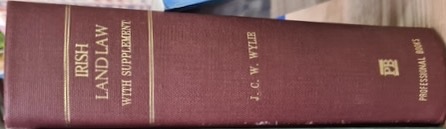
A fine and sturdy pillow.
It was quite comfortable to sleep on; that I do remember. Wylie’s Land Law, I mean. A hefty tome of maybe 1400 pages of legal jargon pertaining to Irish property, equity, trusts and succession. It wasn’t a work I became overly familiar with, mind you, but I can still just about feel the impressions of the book cover upon my forehead. Sometimes I got through a couple of pages before it happened. Mostly it struck me on page one. I’d think, ‘maybe I’ll just have a wee nap before I start, clear the auld cranium a little.’
The book would be shut and carefully positioned. My head would lean forwards, and I’d nod off, listening to the whirl of papers and biros and distant whispers emanating around the Berkeley Library.
It was certainly a mellower sleeping spot than the house where I lived on Heytesbury Lane, a short stumble from the east end of Baggot Street. Technically speaking there were five of us in the house, four young men, one courageous young lady, all students. However, in the ensuing decades I have met many people who tell me, with much authority, how they spent so many nights in our house that they were practically entitled to squatter’s rights. Ours was a party house, for sure. It wasn’t supposed to be a party house, of course, and yet, in hindsight, perhaps all the chaos was somewhat preordained.
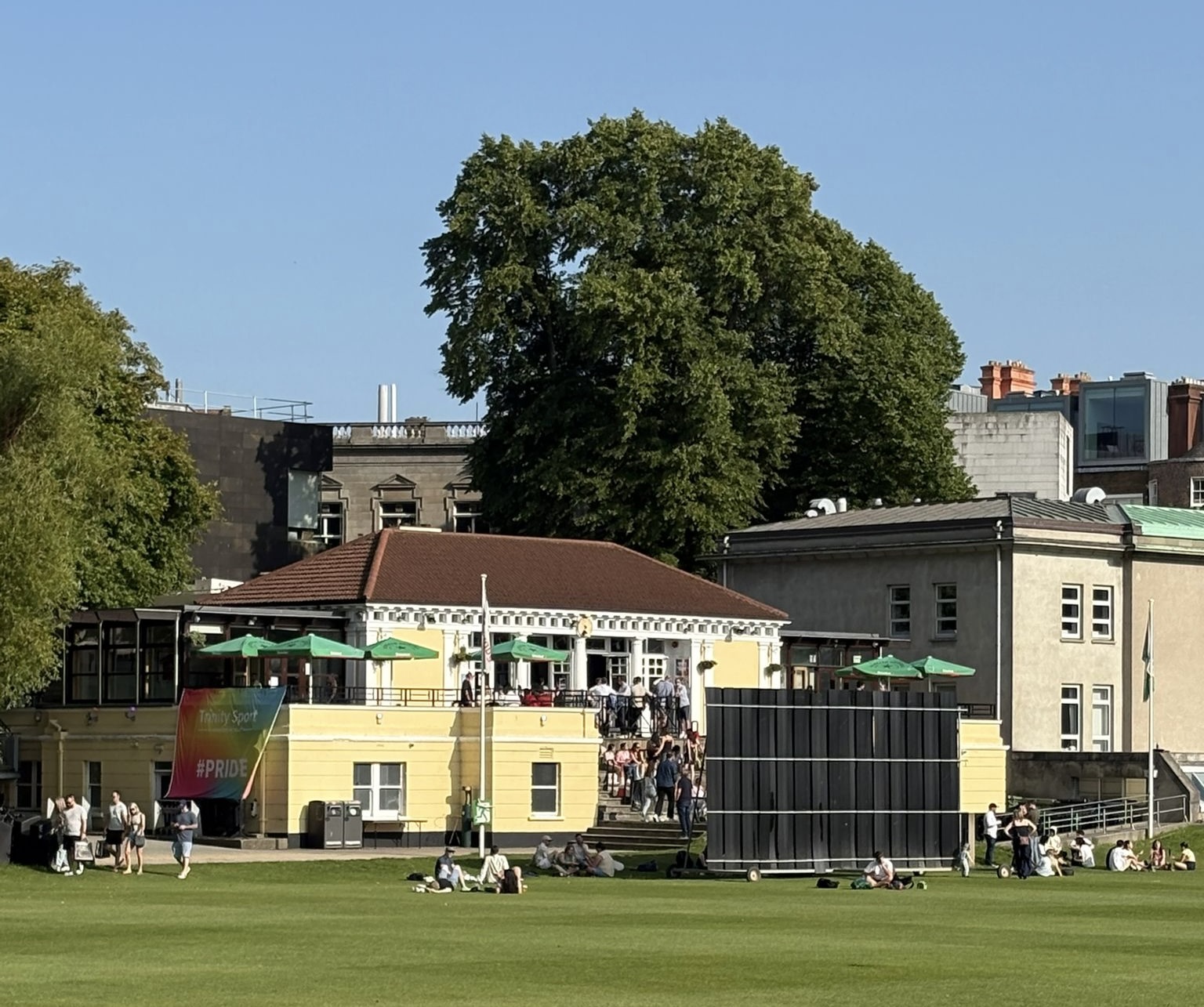
The Pav, June 2025
My Berkeley snoozes rarely lasted more than thirty minutes. When I awoke from my slumber, I would put the nice book away and head outside for a smoke. And then, trance-like, I’d drift across to the soft green playing fields where familiar faces were sure to be soaking up the rays or the rains with some nutritious wheat juice at the Pav. Many a moon might wax and wane before I made it back into the library.
Model student, I was not. From the age of eight through eighteen I was locked up in boarding schools, one in Dalkey, the other in Scotland. I remain convinced that the Oxford & Cambridge examination board botched up and gave me someone else’s A-levels results. They were too good. Having hitherto assumed I would be studying classics at Dunstable Polytechnic, I found that I had unexpectedly qualified to read Law at Trinity. My parents were so thrilled they banished me on a ten-month trip around the world, and I duly headed off to paint gates in Virginia, master the art of poker in Hawaii and flog encyclopaedias door-to-door in the suburbs of Australia.
Globe-trotting was such enormous fun that by the time I started at Trinity in October 1991, I couldn’t take it seriously. A college in the centre of Dublin, brimming with joyous youth, surrounded by amazing pubs. Immensely exciting. My knowledge of the capital prior to this was limited to a few days on the razz at the Dublin Horse Show, and a handful of “cinema” trips with my older brother, which basically involved sneaky scoops in Bruxelles where a prematurely stubbly chin served in my favour. [1] But now I was old enough to drink legally – and could there be a finer city in the world to enjoy such a pastime?!
I was formally registered on 4 October. Hazy memories of my first stroll across the cobbles of Front Square. A hasty dash through a long string of enthused faces trying to convince my fellow Junior Freshman and I that if we joined their camogie team, sci-fi club, theoretical society, etc, we would get all our books at half price forever more. It all seemed more akin to the American high schools I had seen in movies than a solemn seat of learning. I was deeply relieved that initiation ceremonies were not part of the process. Someone presented me with a library card, someone else took me to see the Berkeley and Lecky libraries, after which I sought out some bad company and fled to a pub.

Photo: Alice Beresford
I’ve kept a diary since I was eight. These days I play a game when pals come to stay. I ask them to pluck a 1990s diary off the shelf, any diary. Now choose a page, any page. And when they do, the chosen page unvaryingly finds me either in a pub or at a party, or on my way to one, or recovering from the last one. Frequently I am all of the above at once. Midway through my first law exams, for instance, I find myself consuming a bottle of Buckfast at the Pav and then, fast forward a half-dozen hours, I’m doing knee-bendy dance manoeuvres down at Screwy-Lewy’s on Leeson Street.
Trinity itself plays an embarrassingly small cameo role in those formative years. I blame the law. I just could not grasp it as a subject. It confused me. It made me sleepy. Here’s a sample I copied directly into my diary from one of our books about constitutional law:
‘The terms are not so unambiguous as to prohibit an interpretation of them aided by a consideration of the apparent intention of the legislature in enacting the bill.’
Lines like that had me pinned to my chair in great horror, reaching for my pouch of rolling tobacco.
There were maybe a hundred people in my class and I am still in touch with a number of them to this day. They were a good, kind-hearted, intelligent bunch. It seemed to me like they’d all known each other for ages but that cannot have been right. Indeed, many of them were as giddy as me, euphoric at the prospect of living away from home for their first ever time. I think my year roaming the globe had perhaps made me a little aloof, or maybe I just thought of myself as too cool for school, but I was slow to mix with the class.
I didn’t help my cause when I raised a hand during one of our first lectures and asked ‘What’s your auktass?’ I can still feel a couple of hundred eyeballs swinging around to see what eejit would ask such a question. My Scottish education hadn’t prepared me for terms such as Oireachtas.
Somehow, I survived my Junior Freshman exams intact although, reading my diary, I cannot see how this was possible.

The Front Square, or Parliament Square, at Trinity College Dublin.
Fortunately, I did not deceive myself that all was well. I realised that if I didn’t buckle down, all this would be a colossal waste of time and money. So I signed up to study for Schol, the voluntary exams, on the basis that it might spur me into action. Victory would also secure me free education for the rest of my time at Trinity, as well as complimentary rooms on campus, not to mention the strange rumours that I’d be entitled to graze a sheep in Front Square and march around the Buttery with a cutlass. Emboldened by my decision, I allied myself to a sagacious friend (N. McNicholas) who was also sitting Schol, and we both went to stay with his fabulously strict Mother Superior of a mother in Athlone. She did all that she could for us, turfing us out of our beds before the dawn, time-clocking the hours we spent at our desks and keeping us far from the temptations of Bacchus et al.
It might have worked but, come the exams, the questions did not go my way. Failing Schol was the knockout punch to my fleeting visions of becoming the new Perry Mason. I went on the batter and forgot to stop before the summertime exams came. And then I failed them too. Which meant I would have to do re-sits later in the summer. Fifteen law exams in one year. Everyone else in my class sat five. What on earth have I done to myself?
The situation was increasingly untenable. A family friend urged me to meet with a circuit court judge of his acquaintance. Down I popped to the Four Courts where the genial judge enquired about my legal ambitions. I told him of my miserable plight and admitted that I was contemplating abandoning the course. He leaned in close, glanced discreetly left and right, and said, ‘I don’t blame you, son. Get out while you can.’
So I did.
Or at least I transferred.
A non-academic friend by name of Stu put the notion of a transfer into my head when I called into him for a refreshment one morning. ‘I don’t understand why you’re not doing history anyway?’, he said.
I’ve always been obsessed by history. An inevitable consequence of growing up in a big old house surrounded by historic paintings and furniture. I lapped up history in my school years. I read history books for fun. I never let a historical epic leave a cinema unseen. The notion that I could actually study the subject at university began to make my ears shake.
Fast forward to the winter of 1993 and you couldn’t have found a cheerier student than the 22-year-old from Carlow who was now seated close to the front row, learning about Viking Dublin in the age of Sitric Silkbeard and how the Tudor Viceroys all went demented trying to govern Ireland. I was overjoyed to be studying such topics. Now, it would be erroneous to say that I was henceforth a student of terrific diligence and resolve but I did have a considerably jauntier stride whenever I strolled or cycled into Trinity to attend a lecture.
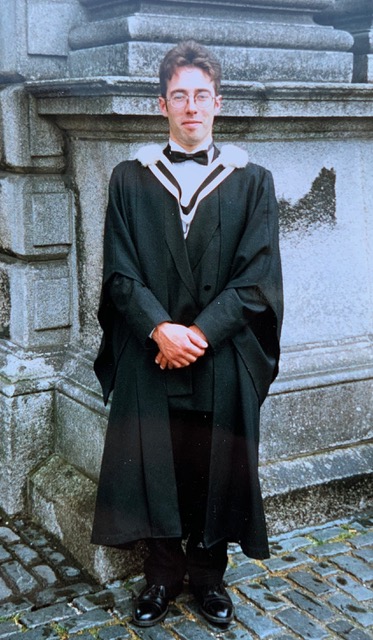
Graduation Day
I subsequently spent a year at Groningen University, where I mastered a different form of Schol, or Skol, if you will. The life of an Erasmus student studying history in Groningen was preposterously easy. My weekly agenda comprised of four hour-long lectures, two of which were conducted by a lecturer with severe hypochondria who quite frequently cancelled them at the last minute. For the remaining 164 hours of each week, I was left to my own devices in the northern Dutch town riddled with coffeeshops.
What’s a guy to do?
However, at least my chosen subject was history, and, between the mischief, I read plenty of books about the long term origins of the Vietnam War and why the South lost the US Civil War and why the Dutch are boring. The last topic was probably the oddest, but they took it so seriously in Groningen that we spent an entire term studying it; a flat landscape and a 400-year-old democracy were cited as the two main reasons.
I made it all the way through college and left with a perfectly good history degree. I honestly can’t now recall if it was a 2-1 or a 2-2. I remember that when it was conferred, I had Jonathan Swift’s beady eyes looking at me reproachfully; my main thesis, an unremarkable work, was an examination of Swift who was about as convoluted and barmy a man as one could possibly find to write about.
I have never once been called upon to show my degree to anyone. However, the historical itch was firmly upon me by the time I donned the gown for the graduation ceremony. Within a month, I was on a flight to Hong Kong where the next chapter of my life was about to begin. History would have to go on hold for a while because, much as I enjoyed my historical studies, Hong Kong just wasn’t yet ready for all my newfound knowledge about Sitric Silkbeard.
I assumed when I left Trinity in 1996 that I’d probably had my fill of history and that a new career would come my way before long. Half a decade would pass before I realised that my love for the subject was absolute and I yielded with a familiar elation when history came full circle to grip me once more.
*****
The original version of this text was published in “Trinity Tales: Trinity College Dublin in the Nineties,” edited by Catherine Heaney and published by Lilliput Press in 2016. It was the fourth volume in the Trinity Tales series. Royalties from the book support the Long Room Library fund.
*****
And here is a little reminder of how life was at Trinity back in the early 1990s.
*****
End-Notes
[1] Remarkably, I found myself swigging lagers outside Bruxelles at 2:30am the night of the Trinity law class’s 30 year reunion on 20 June 2025.