
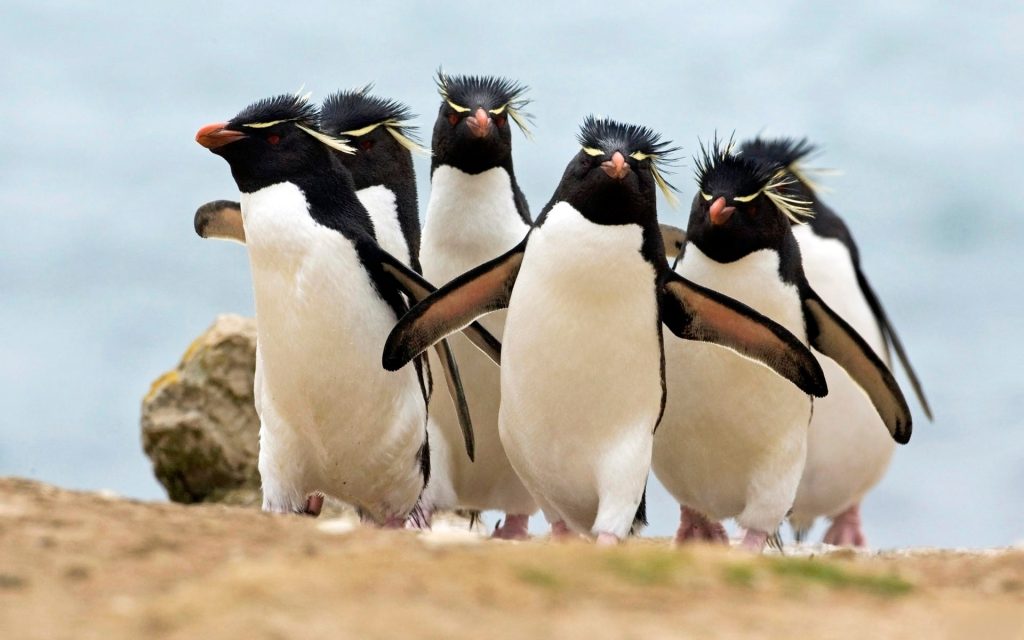
Rockhopper Penguins (Eudyptes chrysocome) on their way to the colony, Falkland Islands, South Atlantic Ocean
I thought of the Falkland Islands whilst grimacing my way through ‘The Iron Lady’ on TV. I was reminded of the theory that Maggie Thatcher’s decision to go to war against Argentina over the Falkland Islands in 1982 was merely a ruse to distract the angry mobs running rampant all over what was becoming a very disunited kingdom. Fast forward to the end of a victorious war and Maggie is suddenly basking in glory with everyone waving Union Jacks from Lands End to John o’Groats, and an economic boom hoving into view.
David Cameron would have been tempted to pursue a similar path if Argentine President Cristina Fernandez had kept up her threat to reinvade the islands. And Lord only knows where Javier Milei might have taken things …
I’ve never quite figured out how Britain can still justify its ownership claims, given that the islands are nearly 8,000 miles from London. It’s possibly all down to Captain John Strong who, en route to Chile, made the first recorded landing on the islands. On 27 January 1690, he noted in his journal: ‘We sent our boat on shore to one of them and they brought on board abundance of Pengwins and other fowl and seal’.
Captain Strong named the sound between the two main islands after the 5th Viscount Falkland who had sponsored his expedition. In due course, the Falkland name extended to cover the whole archipelago.
County Monaghan has a tentative connection to the islands via Falkland Castle, now a ruin, near Glaslough in the parish of Donagh. The castle was built for Robert Maxwell, ancestor of the Earls of Farnham, who was Chaplain to the 1st Viscount Falkland, great-grandfather of the 5th Viscount for whom the islands are named.
Maxwell named both his castle and the townland (here) in honour of the 1st Viscount, a rather bigoted individual who served as Lord Deputy of Ireland under Charles I from 1622-1629. The 1st Viscount’s wife Elizabeth was a woman ahead of her time, a poet, translator and dramatist, who established a number of industrial schools in Dublin. Estranged from the Viscount, their lives descended into a jumble of court cases, bankruptcy and kidnaps. Their eldest son Lucius, the 2nd Viscount Falkland, died fighting for Charles I at the battle of Naseby.
Robert Maxwell’s great-grandson was the Rev Dr William Maxwell, Archdeacon of Clogher (1762-83). He was a close pal of the diarist Dr. Johnson, whom he copied ‘in wig, general appearance, and in manner.’ It is said that Dr. Maxwell was residing in Falkland Castle when the rebels struck in 1798, firing into his bedroom in an attempt to kill him. He survived to die in Bath 20 years later. His daughter married the Rev. Henry Frances Lyte, author of that splendidly sad naval hymn ‘Abide with Me,’ about whom I wrote a chapter in 1847.
William Maxwell Carpendale, a descendant of Robert Maxwell, built a fine Georgian house just over a mile outside Dungannon, Co. Tyrone, at the junction of the Dungannon, Cookstown, Donaghmore and Newmills roads. He named the house Falkland after his ancestors’ home in Monaghan.