
See here for more stories from Vanishing Ireland
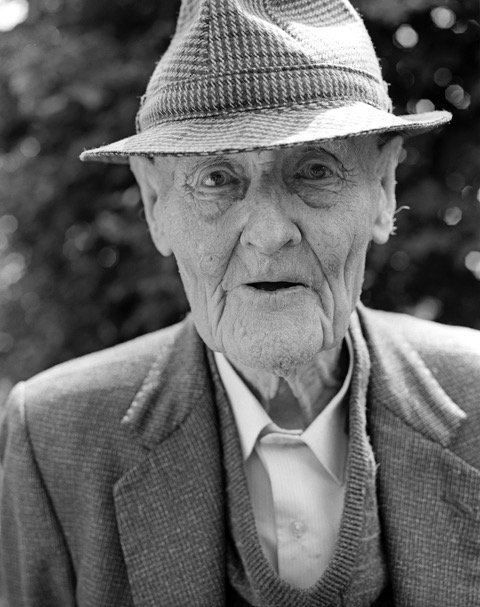
Photo: James Fennell.
On his mantelpiece stands the letter of congratulation he received from President McAleese on 23 June 2002, surmounted by the four Centenarians coins presented on each subsequent birthday. At the age of 104, Bill Burgess presently [2005] ranks as the fifth oldest man in Ireland.
He was born in June 1902, a month after the Anglo-Boer War finally ended. He was ten years old when the Titanic sank, fifteen when his brother Rupert was killed in action in Belgium, 27 when Wall Street crashed, 37 when Hitler invaded Poland, 61 when JFK was shot, 77 when the Pope visited Ireland, 87 when the Berlin Wall came down, 96 when Clinton was impeached and 104 when Israel and the Lebanon went to war.
His grandfather had a 100-acre farm in Bagenalstown. In 1852, he presented a letter of recommendation to the Bunburys, after which he moved twenty miles east and settled in Tobinstown as a tenant farmer. Bill recalled that turnips were growing in ‘one of the long fields by Keppels’ and that, in the absence of any agreement with the landlords, his grandfather drew the turnips out with a bull and threw them in the ditch rather than sell them, so that the former owner was free to come and collect them
Bill was not sure why his grandfather moved to Tobinstown but suggested some form of financial incentive, or an enthusiasm to live near what was by that stage one of the most up-to-date model farms in Ireland. He thinks the Bunburys paid for the construction of the granite farmstead where Bill lived, and that the Burgesses then gradually paid it off. Bill later lived in the same house with his son Edwin and Edwin’s wife Norah. Bill’s father inherited the farm in the 1890s and married a Dublin girl with whom he had ten children. A new building was put up in Tobinstown by Bill’s father in the 1890s.
‘I was the fifth boy’, says Bill. ‘There was a boy, a girl, then two boys, a girl, another boy, then me and three girls after’. If that sounds like a handful, suggests Bill with a contagious grin, then the neighbourhood must have been pure chaos. ‘There were thirty-three children between three houses – we were ten, the Ryans had eleven and the Fishers were twelve’. In about 1905, the Fishers and Ryans had ‘no money’ to pay their rent and were in danger of being evicted. ‘And I don’t mean to brag at all,’ says Bill, but his father stepped in and paid the annuity for both families. Bill believed this was why his family were never touched during the Troubles.
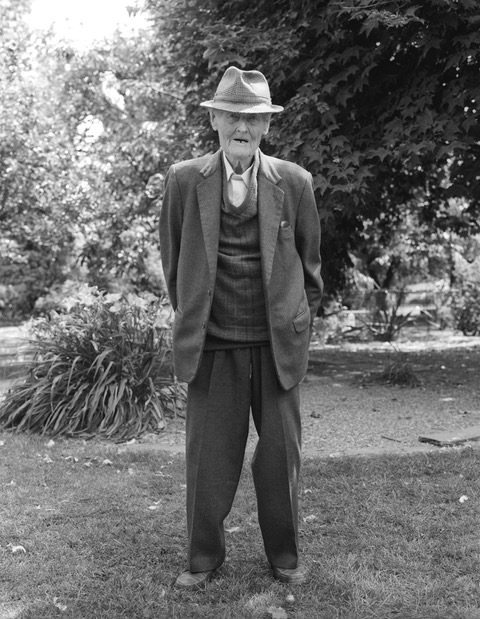
Standing Tall. Photo: James Fennell.
In March 1909, Bill’s father passed away with acute peritonitis. ‘The night he died, we were called over to his bedroom to say goodbye. I was six and my younger sister was a year and a half. I remember her crawling up and putting her hands around to say goodbye to him’.
In June 1917, Bill’s elder brother Rupert was killed fighting for the Australian army at Messines Ridge in Flanders. And then, in 1919, came the Spanish Flu, a horrendous epidemic that annihilated more people in Europe and America than the Great War itself. Bill had been sent to school in Dublin the previous September, ‘very much against my will’.
‘It was the end of October when the schoolmaster came up to me. He was a savage man. He should have been locked up in Mountjoy. He told me a wire has come and asks: “Have you a sister, Vivian?” I say: “No, I’ve a brother Vivian”. Vivian was two years older than me, as hardy a young fellow as you’d meet. “Well”, he says, “he’s dead”. Just like that. If he had hit me between the eyes he couldn’t have done more’.
Bill joined up with two of his sisters living in Dublin and went home immediately. ‘A man met us with a pony and trap’, he recalls. ‘My brother was dead. Another brother and my three younger sisters were down with the flu. There was no antibiotic and no whiskey either. There was nothing to be had. No up-to-date medicines. No pick me ups. Nothing. Dr Kidd in Tullow recommended we get some whiskey or poitin but even that was hard to find’.
Fortunately the family recovered strength and, by the mid-1920s, Bill was fast establishing himself as one of the most proficient amateur jockeys in Ireland. ‘I was like our Lord at the beginning. I started out on an ass before the war. An ass with no hair on its legs!’ He quickly progressed to proper hunters, sturdy beasts with names like Quick March, Lightfoot and Fearless.
In April 1926, Bill mounted a horse owned by his brother Harry, ‘very badly wrong of wind’, and rode him to victory over twenty six jumps in the Farmers & Members Race at the Coolattin Point-to-Point in County Wicklow. He would go on to win the same race on five further occasions, and numerous others at race meetings throughout Ireland.
‘I rode different places for no advantage to myself, only disadvantage. I got no money. You could call it sport if you like – risking your neck on every fence! But you do things at 20 you won’t do at 30, much less at 40’.
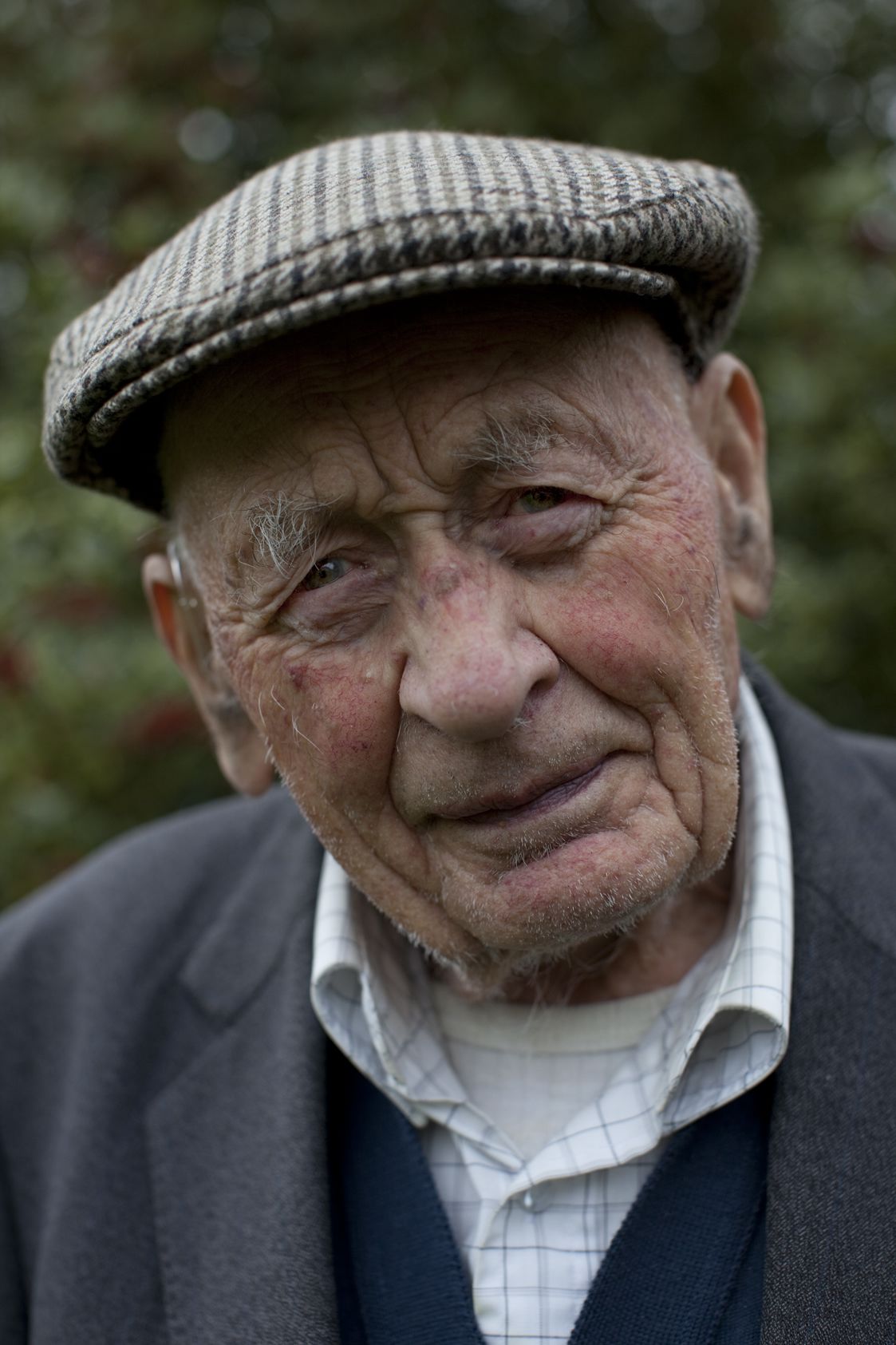
Bill’s son Edwin married Norah Hawkins, daughter of George Hawkins, whose story is told here. Photo: James Fennell
He points to a photograph from 1935 of a stocky young lad seemingly flying through the air. ‘That was taken at the last double-bank in Coolattin. I was fired head-over-heels over it. The horse was Brown Jack and he ended up dead on one side and I landed on the other with a dislocated ankle. I hopped up as best I could. I got up on another horse and I won the next race’
On another occasion, he was invited to Kilmallock to participate in a race.
‘I got my breakfast here at 8 o’clock in the morning and I went the 100 miles with my brother-in-law. That was a long journey. We walked the course and I rode the race and I won a prize for the owner of £25. Afterwards he gave me great praise and asked would I like a drink? I wasn’t a drinker anytime so I said I’d have a grapefruit. It cost the sum of four-pence in the ordinary way. And that’s all the thanks I got. I nearly gave up riding after that.’
When not riding horses, Bill was running the family farm, harvesting wheat and supplying milk to the Lucan Dairies in Dublin. In 1957, he took a wife but it was to be a dreadfully short marriage. ‘Two and a half years later I was back in church again to bury her’. He was left with a small boy, Edwin.
Bill is an old school gentleman. He stands up when someone enters a room. He insists on walking them to the door when they leave. He believes that life is a precarious affair and every moment of happiness must be appreciated. ‘Isn’t it a funny thing’, he remarks, ‘that of all the men and women who ever walked this earth, not one of them ever knew what happens afterwards’.
‘I have no control over it’, he says of his longevity. ‘But when I’ve gone? Well, as the man used to say when we’d meet on a bank in a chase, “Cheerio till the other side!”’
*****
Bill Burgess passed away at Glendale Nursing Home in Tullow on Monday September 17th 2007. At the age of 105, he was ranked as the second oldest man in Ireland. Within weeks of his death, the oldest man passed on. Bill would have loved to have been the oldest man in Ireland. As it was, he was the oldest farmer. He was survived by his son Edwin, daughter-in-law Norah, grandchildren Neil and Fiona, nieces, nephews, relatives and friends. Norah is the daughter of George Hawkins of Ballyhackett, who appears in the third volume of the Vanishing Ireland series.
Vanishing Ireland – Bill Burgess from AWAY2TRAVEL on Vimeo.
*****
*****
A Tribute to Bill Burgess from the Ballon-Rathoe Chronicle, Christmas 2003:
Bill, aged 101 years is a truly amazing man, unique and extraordinary in every way. He is blessed with a most incredible memory as well as being a most articulate and polite gentleman. It is awesome to think that Bill had his first leg-up at Kellistown over 80 years ago and when I spoke to him earlier this year he could recall those historic times clearly and with a twinkle in his eye.
One small example is his vivid memory of being with his father at Friarstown Point-to-Point when he was a mere five years old and seeing – Bill recalls his father’s horse Talbotstown win a race there – Bill recalls quaintly “I remember coming home from the races, sitting in the well of the pony and trap with the €5 prizemoney for winning the race” Bill adds that Paddy Hearne rode the horse. The Hearnes ran a successful butchers shop in Carlow. Bill rated “the Kellistown track to be the fairest of all – a true test of horse and jockey”, adding that any horse who won in Kellistown was fit to race anywhere”. That observation was certainly true as many of the winners there later won at the widely acclaimed Punchestown festival.
Bill rode for many years at Kellistown and his first mount there in 1922 was on a horse called Whitestown which was beaten into second by Mr. † Jeffer’s Kildrenagh (Mr. EB. Roark) – the winning distance being two lengths. Later in the day Bill finished fourth on Cronolea in the Foxhunters Stakes which, incidentally was won by Mr. Blanch Kehoe’s mare Comrade (Mr. P. Sheehan up). Another horse that Bill has fond memories of is a horse called Spy Wednesday – aptly named according to Bill as the foal was born on Ash Wednesday!!. In 1924 Bill rode this horse into fourth place in the Farmer’s Race and three weeks later he had a ‘sweet’ win on Spy Wednesday in Coolattin.
However Bill had to wait until 1932 to have his first winner at Kellistown when he won The Carlow Hunt Race on Miss M. O’Meara’s brown gelding Punster beating Mr. Hardy Eustace Duckett on Johnstown Dwarf by 8 lengths. On the same day Bill was second on Capt. H. Woodhouse’s The Wicklow Star. Bill had the leg up for the very last time at Kellistown on March 19, 1936 when he rode a horse owned by Mr. B. Braddell, Concrete into third place in the Open Heavy Weight Race, thus bringing down the curtain on an illustrious career in the saddle which, at Kellistown at least, spanned 14 memorable years.