
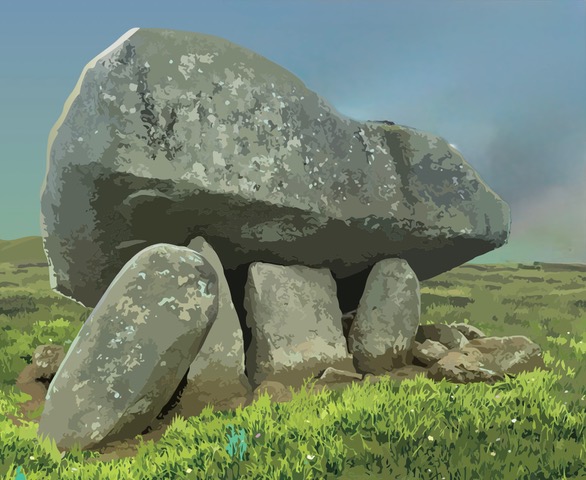
Browne’s Hill Dolmen. Illustration: Derry Dillon.
See here for further stories from County Carlow.
*****
The stories below include those of Arthur Kavanagh, a man born without limbs who became an explorer, as well as a Czech engineer who invented the water-bike, the murder of a Hollywood director, the prince of Antwerp who made Carlow his home, the crazy doctor who blew up Carlow Castle and the mystery of one of the world’s biggest ancient monuments.
*****
Brownshill Dolmen
Located 3km east of Carlow Town on the R726 Hacketstown Road, the Brownshill Dolmen is a 6,000-year-old man-made burial tomb. Its massive, weather-beaten granite capstone is estimated to weigh a whopping 103 metric tonnes.
That’s about the same weight as seventeen fully grown Indian elephants or a Boeing 757 jet. If the All Blacks and the Lions rugby teams were to unite with the hundred strongest National Football League players from the USA, they would struggle to nudge the Brownshill capstone by an inch. So how did they get the capstone up there? [1]
The dolmen is thus one of the largest single manmade Neolithic formation in Europe. As you walk to the dolmen, keep your eyes peeled for the famous “Carlow Fencing”- granite posts, V-shaped at the top, with granite slabs laid across, a common feature of the Carlow landscape in the 19th century.

An illustration of Carlow Castle by Joe McLaren from Turtle Bunbury’s ‘Ireland’s Forgotten Past (2020). See here for a full history.
Patron Saint of Luxembourg
The English monk St Willibrord and his Benedictine mentor, St Egbert of Ripon attended the monastery at Rath Melsigi, near Clonmelsh, the preeminent Anglo-Saxon ecclesiastical settlement in Ireland in the 7th an 8th centuries.
Willbrod studied at the famed monastery for 12 years before he was ordained at Old Leighlin. His signature is the oldest datable signature for any English person and is contained in a book that was originally written at Rath Melsigi (pronounced Rath Melziggy in Luxemboug!).
In 690, Willibrord set off on his mission in the Kingdom of the Franks by preaching to the recently conquered Frisian populace in the modern-day Netherlands. He was made Bishop and then Archbishop in the Netherlands before founding an important abbey and scriptorium at Echternach Abbey in Luxembourg. His role in the Carolingian Renaissance is one reason why he is today hailed as the patron saint of Luxembourg.
Carlow Castle
The stone fortress at Carlow Castle was built by William Marshal, the greatest (and richest) knight of his generation. His wife Isabel was the sole heiress of the Norman baron Richard de Clare (Strongbow) and Aoife, the daughter of Dermot MacMurrough, King of Leinster.
Completed in 1213, Carlow’s central keep rose 70 feet high and was flanked by four drum-towers.
Lionel, Prince of Antwerp
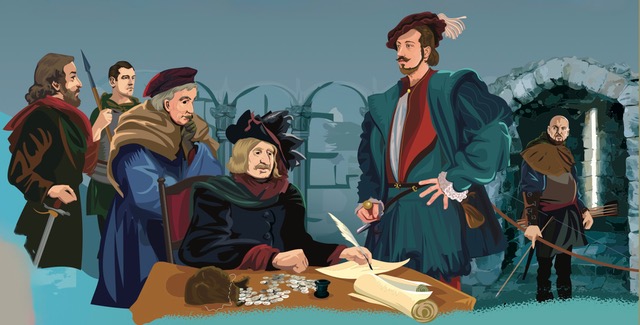
Illustration: Derry Dillon
In 1361, Lionel of Antwerp, Governor of Ireland (and son of King Edward III of England), ordered the Exchequer to be relocated from Dublin Castle to Carlow Castle.
When he moved the Court of Common Pleas to Carlow the following year, the castle became home to a sheriff, a constable, a man-at-arms, two lawyers and a chief serjeant, as well as numerous money-collectors, clerks and eight archers.
Both the Exchequer and the Court returned to Dublin after Lionel left Ireland in 1367. He died soon afterwards, aged 29, having allegedly been poisoned by his Italian father-in-law.
For more on Carlow Castle, see here.
St Patrick’s College
One of the oldest Catholic seminaries in Ireland opened in 1795 to educate priests following a relaxation of the Penal Laws against Catholic education. When I attended a superb lecture on St Patrick in 2024 by Dr Elizabeth Dawson, Tom McGrath said the history department now had 7 full-time staff.
Monsignor Caoimhín O’Neill (1944-2023), known as Father Kevin, was one of the leading lights in Éigse and president of Carlow College (1994-2015). He was a major advocate for the creation of what became Carlow’s VISUAL Centre of Contemporary Art & The George Bernard Shaw Theatre. See here.
Currently, St Patrick’s College, Carlow, has approximately 600 students enrolled across all its programmes, including humanities and social studies.

Illustration: Derry Dillon
The Blasting Doctor
In 1814, Carlow Castle was bought by Dr Philip Middleton who planned to convert it into a psychiatric asylum.
When he tried to widen its windows with blasting powder, the explosives caused the two eastern towers to collapse, along with three quarters of the adjoining walls.
Amazingly nobody was hurt.
Newfoundland Duelist
In 1826, Carlow-born Captain Mark Rudkin, a son of William Rudkin, became the last person known to have fought a duel in Newfoundland, having shot Ensign John Philpot of the Royal Veteran Companies. See here.
Carlow Cathedral
The Carlow Nationalist had a bit of craic earlier this century when it published a photograph of the town’s mighty Gothic Revival Cathedral (built between 1828 and 1833) with the famous spire carefully airbrushed out. It was April 1st and the story ran that the spire had been knocked down by a helicopter. Apparently certain old and devout readers of the paper damned near died of a heart attack at the news. And even the Vatican was on the blower protesting that this was all in very bad taste.
The Cathedral was one of the first Catholic churches to be built after Daniel O’Connell’s success in securing Catholic Emancipation in 1829. The church was constructed with local materials, including grey-blue stone from a quarry on the Tullow Road and granite from a nearby quarry supplied by Colonel Henry Bruen. Inspired by the Belfry of Bruges in Belgium, the perpendicular semi-Gothic design is by Thomas Cobden, and indicates the beginning of a new age in Gothic Revival architecture set to sweep the British Isles on the eve of Queen Victoria’s accession.
The Seven Oaks
The “Seven Oaks Hotel” was built as a family home in around 1820 by Samuel Haughton, a Quaker, and originally known as “Greenbank“. It was considered for use as a fever hospital around 1840. Wilfred Haughton lived here in 1845 and planted daffodils in an arrangement showcasing Wellington’s troop movements in Waterloo. After his death in 1898, the house passed to his sister and her husband, Rev. J. Jameson.
An RIC inspector John Brooks lived here in 1908. Michael Molloy, of the Tullow Street drapery shop purchased the building in 1912. In 1948 it was purchased by the administrator of Carlow Cathedral. In the 1950’s it opened as the “Crofton Hotel.” It later became the “Oakland.” In 1977, it was renamed the Seven Oaks Hotel.
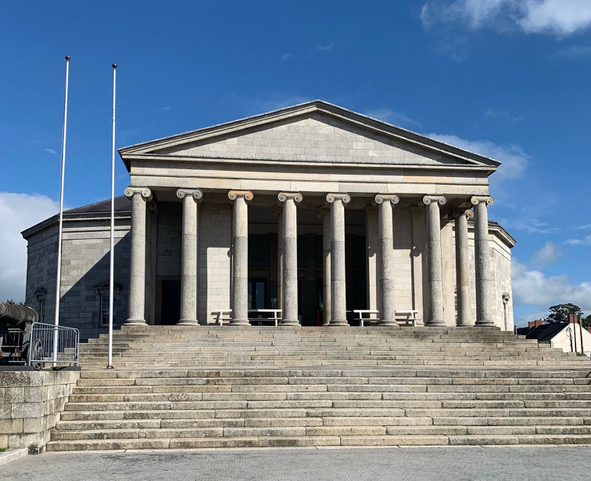
Built in 1830 by William Vitruvius Morrison, Carlow Court House is considered one of the finest Neo-Classical buildings in Ireland.
Carlow Courthouse
Completed in 1830, Carlow Courthouse is based on the Temple of Ilissus in Athens. Designed by the Clonmel based architect William Vitruvius Morrison (1794-1838), it features an Ionic portico with eight columns, resembling the ancient Greek temple’s architectural elements. It also boasts Crimean canons and decorative pikes on its railing.
Morrison’s father, Sir Richard Morrison developed this neo-classical style during the Napoleonic Wars, along with his arch-rival, Francis Johnston.
Morrison was also responsible for the Court House in Tralee, County Kerry. Neither of these buildings are quite as stern as other Greek Revival structures, although they are no less imposing for this.
The Neo-Classical movement in Ireland gained much ground during the 19th century, particularly under James Gandon (who designed Dublin’s Four Courts and Custom House). Such buildings were inspired by Roman and, later, Greek, buildings, as noted by individual architects during field trips to Italy and Greece, or from the etchings of the great Piranesi and publications such as Antiquities of Athens by Stuart & Revett (1762, 1790).
By the 1820s, the Greek Revival had taken a hold throughout Europe and the United States. This was a decade when many of the brightest minds seem to have been serious, sober and downright glum. Maybe everyone was just plain exhausted by the previous 40 years of bloody revolution and warfare. At any rate, architects decided to reflect the new thought by designing structures to be … well, serious, sober and downright glum. Buildings were stripped of all unnecessary distractions or embellishments. Every aspect was clearly distinguished. There was no room for messing about. The net result was a heap of brand new, rather imposing buildings, generally court houses and prisons, that wagged a stern finger at any who dared to mock, snort or chuckle without permission.
I got to know Carlow Court House quite well when summoned for jury service in the closing weeks of the 20th century. The case was to be a highly complex and tedious fraud issue. 200 potential jurors were imprisoned in the Court House for close on two days before the lawyers managed to swindle a dozen of us into volunteering. The main hazard of being a juror is that your company is meant to carry on paying your wage regardless of how many weeks you have to remain in court. I secured my freedom from such obligations by reasoning that I was self-employed and, should the court case last longer than a week, I would be left with no alternative but to resort to fraud.
The Whiteboy Towers
‘Built in the early 1830s, the Whiteboy Towers were named for a group of agitators who arose in the Carlow area just after Emancipation. They were militant Catholics, impatient with the Protestant authorities, who took an aggressive and combative stance between 1830 and 1835. At Milford, mobs raided the homes of local farmers, took several stands of arms and threatened others. As this was done in broad daylight, John Alexander I sought redress from Dublin Castle in 1833; the castle duly sanctioned the establishment of a police barracks on Milford Bridge later that year. “This station was regarded by the local Catholic population as a part of the Alexander estate infrastructure. In contemporary letters, reports etc. the Protestant authorities refer to these attackers as “Whiteboys”, harking back to the agrarian agitators of the 1770s. The towers were basically fortified farmhouses, with circular viewing towers with observation slits for panoramic views. They were built by landlords in expectation of a significant attack. The small number of such structures shows how quickly such fears evaporated.”
With thanks to Shay Kinsella.
The Hanging of Lucinda Sly
On 30 March 1835, 10,000 people gathered on the streets of Carlow to witness the last public hanging that ever took place in the town. The luckless duo to face the hangman’s noose were Lucinda Sly, a 58-year-old Protestant landowner, and her 26-year-old lover John Dempsey, a Catholic labourer who worked for her. They were condemned for the murder of Lucinda’s husband Walter Sly, a wife-beater by repute, at his home in Old Leighlin.
Carlow Gaol, where they hanged, is now the Carlow Shopping Centre, while the trapdoor from the scaffold is on show at Carlow County Museum. Located on Centaur Street off the Haymarket and to the rear of the Town Hall, the museum contains a fine smattering of bits and bobs from Carlow’s past including furniture, crockery, clothing and folk instruments.
Georgia’s Last Dueling Fatality
Charles Dawson Tilley was born on 16 June 1845, educated at Trinity College and later Paris. He is said to have had an uncle who was a clergyman in the Church of Ireland while a sister reputedly married a noble. (See here and here.) He was either from Carlow or Wicklow. * In 1865 he emigrated to Augusta, Georgia, where he became a broker. He died in a duel on 17 December 1875, defending the honour of his landlady Mary Clark de l’Aigle. The victor George E. Ratcliffe, who had been spreading rumours that Tilley and Miss de l’Aigle were an item. They met on the South Carolina side of the river at Sand Bar Ferry. Both men fired Colt Navy 6-shooter pistols. Tilly was mortally wounded and so became the last Georgian man to die from duelling. The de l’Aigle family buried him beneath a large Celtic cross in their grave plot in Magnolia Cemetery.
The last duel ever fought in Georgia was in 1889 between JR Williamson and Patrick Calhoun, a grandson of the former vice-president.
* His Carlow birthplace is cited in The Augusta Constitutionalist. (Augusta, Ga.), 18 December 1875.]
Sir John Macneill & Carlow Train Station
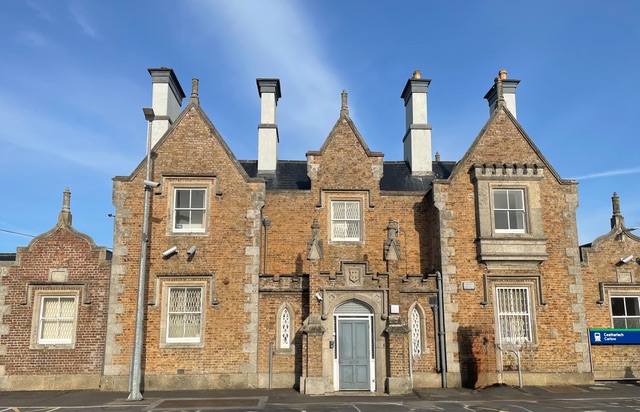
Carlow railway station, April 2025, image cleared of signage.
Carlow’s charming railway station was built in 1846 to the design of Sir John Macneill (1793-1880), the Louth born civil engineer who had erected the massive passenger shed at Kingsbridge (Heuston Station) in Dublin a year earlier.
A lieutenant in the Louth Militia from 1811-1815, Macneill had gone to England at the close of the Napoleonic Wars to find work as an engineer. He became one of Thomas Telford‘s principal assistants during that man’s phenomenal era of road and bridge building in Scotland and England during the 1820s.
Macneill set himself up as a consultant engineer in 1834, with offices in London and Glasgow. His skill and application encouraged the House of Commons to commission him to undertake a survey of northern Ireland for the railways. Moving into the family home at Mount Pleasant, County Louth, he duly completed the Drogheda – Dublin line (later the Great Northern Railway) and, on the completion of the Kildare section of the Great Western & Southern Railway in 1844, he experienced the pleasure of having Her Majesty Queen Victoria gently attempting to slice his ears off and make him a knight.
He was 1st Professor of Civil Engineering at Trinity College Dublin from 1842 to 1852 and was later created a Fellow of the Royal Society. During his later years he went blind and retired. He died on 2nd March 1880 at Cromwell Road in South Kensington, London.
The station was built to welcome coal-faced passengers off the new Great Southern & Western Railway which arrived in Carlow in 1846. Macneill’s penchant for Jacobean stepped gables are still in evidence today. Ain’t it a crying shame that they don’t make train stations, or indeed trains, like they used to.
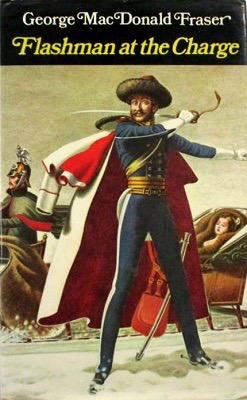
Louis ‘Lew’ Nolan is a central figure in ‘Flashman at the Charge’ by George MacDonald Fraser, was serialised by Playboy in 1973.
Charge!
Louis Nolan, the cavalry tactician who died in the Charge of the Light Brigade during the Crimean War, was a grandson of Babington Nolan, whose family came from County Carlow. Babington Nolan, a trooper in the 13th Light Dragoon, died of yellow fever in Saint Domingue, Haiti, in 1796.
Captain John Babington Nolan (c. 1786-1850), Louis’s father, owned the Adelphi estate in Tobago and served as British Consular Agent and Vice-Consul in Milan. I think his wife Frances died at Walworth in 1808. (here).
They may connect to John Nolan of Kilbaleyhue House, Tinryland, County Carlow, who was buried in Sleaty.
Potatoes at Dawn
‘A DUEL WITH POTATOES.
In County Carlow, Ireland, an aggrieved member of a certain congregation, declining to accept his parson’s assurance that he was not one of the sot of miserable sinners rather pointedly referred to in the Sunday sermon, challenged his vicar to personal combat, and offered him his choice of weapon. The challenge was accepted, the clergyman declining, however, to use such secular arms as swords or pistols, but expressing his willingness to try a novel kind of ammunition – i.e, raw potatoes – to be used as missiles, the bigger the better.
The morning on which the novel duel commenced was as raw as the potatoes, which lay in heaps by the side of each combatant. The potatoes were to be thrown alternately. The challenger commenced and missed, The clergyman, aiming calmly and scientifically, raised with his first shot a bump upon his opponent’s forehead almost as large as the missile which caused it.
The layman promptly lost his temper, and aimed wildly and recklessly, hitting the second and missing the vicar with great regularity. The vicar, feeling that he could afford to be magnanimous, put down his potato, advanced to his aggrieved parishioners, held out his hand, and said, “Come, Mr O’R, I think we’re & couple of idiots. Let us shake hands and be friends, and utilise those vegetables for a more peaceful purpose at dinner to-night.”.
Reported in The North Otago Times, 11 September 1890, p. 4.
The Remarkable Mr Kavanagh

Arthur MacMurrough Kavanagh, P.C., M.P. (1831-1889)
The Kavanaghs are descendants of the McMurrough Kings of Leinster. Among their number was the Incredible Arthur Kavanagh. Born at Borris House in 1831, with stumps instead of forearms and lower legs, he nonetheless managed to travel the world and represent Carlow in the Westminster Parliament from 1868 to 1880.
His well-to-do mother insisted he be treated just like her other children and the boy grew up to be an intrepid traveller, as well as a noted sailor, a keen angler, a passionate huntsman, an amateur photographer, a best-selling author and a father of seven.
In his twenties, he travelled overland from Scandinavia to Persia (Iran) and worked as a postman on the west coast of India.
Listen to Turtle’s 2022 podcast about Arthur here.
Tyndall of the Sky
John Tyndall (1820-1893), the physicist credited (sort of correctly) with working out why the sky is blue. I don’t know what his answer was, but he did considerably better than a Finnish contemporary who wrote a long thesis maintaining that the sea level fell because there was a hole in the bottom of the ocean. Born in County Carlow, John was professor of physics at the Royal Institution of Great Britain (1853 to 1887), in succession to Michael Faraday. The Salt Bar used to be called the John Tyndall in his honour.
The Senator of Colorado
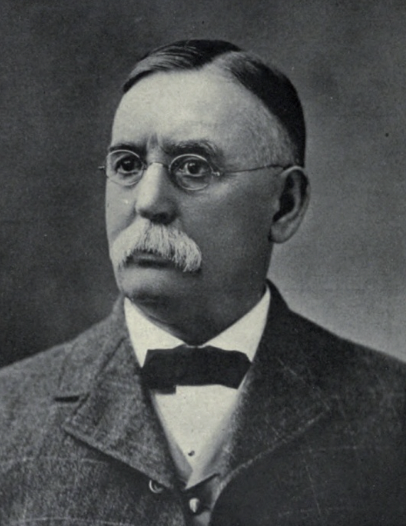
Thomas MacDonald Patterson (1839-1916), the Carlow-born senator of Colorado.
Born in County Carlow on 4 November 1839, Thomas MacDonald Patterson emigrated to the US with his parents, James and Margaret Patterson, when he was 10 and settled in New York, where he attended Astoria School on Long Island. In 1853, they moved to Crawfordsville, Indiana, where he helped out in his father’s jewellery shop. Having studied law in Crawfordsville, he became a circus manager with two local boys, Huff and Elston, bringing it through Indiana and Michigan. (Crawfordsville Weekly Journal, 17 January 1902, p. 1.)
In 1872, he moved to Denver, where he started a law practice and was city attorney in 1873 and 1874. From 1901 to 1907, he was Senator of Colorado. He died on 23 July 1916 and was buried in Fairmount Cemetery, Denver. A detailed biography can be found here, as well as his obituary from The Walsenburg World here. Details of the Thomas M. Patterson Family Papers can be found here.
A New Plough
‘A NEW AND USEFUL PLOUGH. .
The Agricultural Gazette states that a Mr P. Haulen, of Grangeford, Carlow, a large tillage farmer, has invented a plough of singularly novel construction.
The mouldboard is attached to the wooden frame, running on two wheels of 30 inches in diameter. One of these wheels runs on the unplowed land while the other, set at an angle of 4 deg. is against the edge of the last cut furrow: A seat, as in a mowing machine, is on the frame, and the driver sits on this, and has nothing to do but direct his team. A lever on his left hand raises and lowers the breast work and controls the path: An adjustment on the wheels provides for the width and depth of the cut. Having once started and properly opened the land, the rest of the work requires no skill or experience, as it is all automatic.
A public trial of this new implement was made near Dublin, before a considerable gathering of the principal farmers of the district. A couple of ponies were tackled to the seat, as in a field mower and they ploughed in succession a stiff piece of grass, some potato land with a heavy subsoil, and a very heavy stubble.
The work done was extremely good, and to the surprise of all, the draught was so light that the ponies were able to turn a sod of 13 inches by 8 or 9 inches, with ease. A pair of horses will plough about an acre and a half (English) in a day. The inventor says that on his own land this plough saved him at least £50 or £60 last season.’
Traralgon Record (Victoria, Australia), 30 Apr 1886, p. 2.
The Mayor of Hamilton, 1888
Sylvester Doran (1789 -?) and Elizabeth Doyle (? – 1886) from Carlow were the parents of William Doran (1834-1903), who was born at Grimsby, Ontario, Canada. He served as the Mayor of Hamilton, Ontario, from 1888 to 1889. He was buried in Hamilton Cemetery, as per here.
Duckett’s Grove

The poster for the 2013 History Festival of Ireland depicting Duckett’s Grove by the eminent Derry Dillon.
This majestic Gothic Revival ruin was originally home to the Duckett family, prosperous landowners of Cromwellian stock. The house was built in the mid-Georgian period but substantially modified and gothicized by Thomas Cobden into a Gothic Revival Castle later on. William Duckett died in 1908 leaving quarter of a million pounds which is roughly the equivalent to being able to purchase four stealth bombers and a Black Hawk in the modern age.
Alas his widow Georgina Duckett became increasingly deranged and fearful of a Catholic conspiracy to kill her. She fell out with her only child, a daughter named Olive, who was then cut out of the will save for what was known as The Angry Shilling.
The IRA occupied the house in 1922, after which it was sold to a conglomerate of local farmers. It burnt down in 1933. In 2005, the demesne was purchased by Carlow County Council who stabilizeed the house and restored the gardens and stables. (Although the house really does make for a spectacular ruin).
Young Corbett II, Heavyweight Champ
William H. Rothwell (1880 –1927), aka Young Corbett II, was Denver’s first and only world boxing champion. He took the name “Young Corbett II” in honour of his manager, Jimmy Corbett, a former heavyweight champion and was the only man who ever defeated John L. Sullivan (hence the “man who beat the man”. Rothwell became the World Featherweight championship in 1901 and held it until 1902. According to The Rocky Mountain News, 11 December 1901 (here), his grandparents were born in County Carlow and emigrated to Canada. See his entry in the Hall of Fame here. He died on 10 April 1927 and was buried in Littleton Cemetery, Arapahoe County, Colorado.
Air Ace
Jimmy McCudden, the most decorated British airman of the First World War, was the son of Carlow-born Sergeant-Major William H McCudden. See: The Irish Air Aces.
The American Carmen
The soprano and actress Dorothy Jardon (1883-1966), aka Mary Jardon, billed as “the American Carmen” was born in New York, the daughter of Ignace Jardon, a chef who immigrated from France in 1864, and his wife Bridget Mary Kavanagh, who immigrated from Carlow in 1884. As The Irish News and Chicago Citizen put it on 21 October 1921 (p. 2):
‘DOROTHY JARDON, IRISH-FRENCH STAR COMES TO THE PALACE.
Dorothy Jardon, the sensational young operatic star now appearing in vaudeville at a princely salary, will he the headliner-extraordinary at the Palace Theatre next week. Miss Jardon was accorded a tremendous ovation on the occasion of her first appearance with the Chicago Grand Opera Association Company, two seasons ago, as a co-star with Edward Johnson in “Fedora.” Chicago critics acclaimed her as one of the greatest dramatic sopranos of the age and the possessor of exceptional ability as an actress. This gifted young woman, still in her early twenties is Immensely popular in musical dramatic circles in the East. During her recent engagement at the Majestic theatre, she was the recipient of many magnificent floral tributes. Her father is a native of France and her mother a native of Carlow, Ireland. She is one of a family of twenty children.’
Murder in Hollywood, 1922
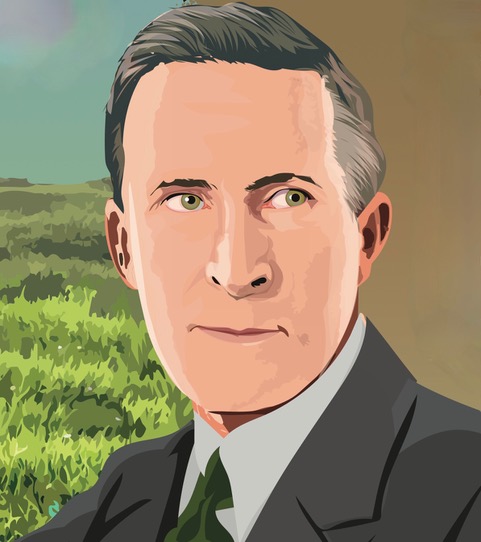
William Desmond Taylor. Illustration: Derry Dillon
Carlow native William Desmond Taylor directed 60 silent films before his sensational murder in Los Angeles in 1922. His father was the first captain of Carlow’s Volunteer Fire Brigade. Born at Newgardens on the Athy Road, Taylor spent his childhood at Elms House (now The Elms), near the Seven Oaks Hotel. Following a row with his father in 1889, the 18-year-old sailed for the US and went to work on a dude ranch in Kansas. By 1914, he was directing films with icons such as Mary Pickford, as well as the first screen adaptations of ‘Tom Sawyer’, ‘Huckleberry Finn’ and ‘Anne of Green Gables’ (now better known as ‘Anne with an E’.) He was shot dead in a case that remains unsolved over a century later.
The One-Minute Butter Churn
Carlow-born Ida M Murphy was educated in Birmingham before she emigrated to Manhattan. In 1902, she invented the ‘One Minute Churn’, which was claimed to be “a household necessity that will not only make butter in one minute, but can also be used to freeze ice cream at odd times.” She was president of the One Minute Churn company, a New York corporation organized in 1902 for the purpose of manufacturing and selling one minute butter churns. It did not run entirely smoothly. See here and here for more.

Máire Nic Shiubhlaigh. Illustration: Derry Dillon.
The First Cathleen
Máire Nic Shiubhlaigh (1883 – 1958) was a founder-member of the Abbey Theatre and was leading lady on its opening night in 1904, when she played the title role in W. B. Yeats’s Cathleen Ni Houlihan. Her father, Matthew, was a printer and publisher from County Carlow (of a County Kilkenny family) who became proprietor of the Gaelic Press.
The Curious Wilsons
Annie Marie O’Toole (1865–1936) from Carlow married Alexander Wilson (1864–1919), from Winchester, Hampshire. Their eldest son – and second of four children – was Alexander ‘Alec’ Wilson (1893–1963), here, a novelist, spy, MI6 agent and serial polygamist, who wrote under the names Alexander Wilson, Geoffrey Spencer, Gregory Wilson, and Michael Chesney. Alec later became professor of English Literature, (later to be appointed as Principal) at Islamia College, Lahore, India. His grave inscription in Milton Cemetery, Portsmouth, evidently notes his polygamy: “He Loved not wisely but too well.”
Wilson’s deceptions on his wives were dramatized in the 2018 BBC miniseries Mrs Wilson, in which his granddaughter, actress Ruth Wilson, portrayed her grandmother, Wilson’s third wife. Wilson’s son was the World War Two poet Captain Dennis B. Wilson (1921-2022), see here.
Siucra, Athy Road
Smells are amazing things for transporting one back to the mysterious freedom of childhood. Musty old books. Chlorinated swimming pools. Fresh mown lawns. And, for me, sugar beet. About 15 miles from my home stands Carlow’s “Siucra” Factory which has been churning up sugar beet since 1926. Napoleon Bonaparte invented sugar beet as a two-fingered gesture to the English who, following his conquest of Spain, had barred the export of sugar from the colonies to ze French Republic. A home grown sugar beet industry meant the French didn’t have to import sugar in order to drink sweet café.
In 1926, Carlow businessman Edward Duggan spear-headed the establishment of the Irish Sugar Manufacturing Company in Carlow. The Most Rev Dr Patrick Foley, Bishop of Kildare & Leighlin, turned the first sod on the site where it stood until its closure in March 2005. You can watch him do so on Pathe news, with Edward Duggan beside him, an excellent website. Although it was a sugar factory, it was always just called the beet factory. Construction was completed in record time and processing of that first sugar beet commenced in mid-October. This was the work of the Moravian genius Franz Schwatshke, Electrical Engineer with the Irish Sugar Company from 1926 until his retirement, father of the eminent artist John Schwatshke. At the end of that first harvest – or campaign, as it was known – in Jan 1927, the beet factory had produced 13,400 tonnes of sugar from 86,000 tonnes of beet. The beet was brought to the factory on horse and cart and by canal boat from farms all over the counties of Carlow and Laois. It sounds like damned hard work, working long hours with your bare hands, children with sacks tied around their legs, thinning the beet and battling with thistles and scotch and chopping the leaves off. Alas, they closed the factory down in 2005.
Patrick and Emmet Bergin‘s father worked here during the 1950s and 1960s. An actor himself, he was much involved with the very first Eigse Arts Festivals. Emmet was a household name in Ireland for many years, playing silver-tongued Dick Moran in Ireland’s long-running agri-soap “Glenroe“. His brother Patrick stalked Julia Roberts in “Sleeping With the Enemy” before going head to head and losing against Kevin Costner in the summer of 1990 when two huge Robin Hood movies were released at the same time.
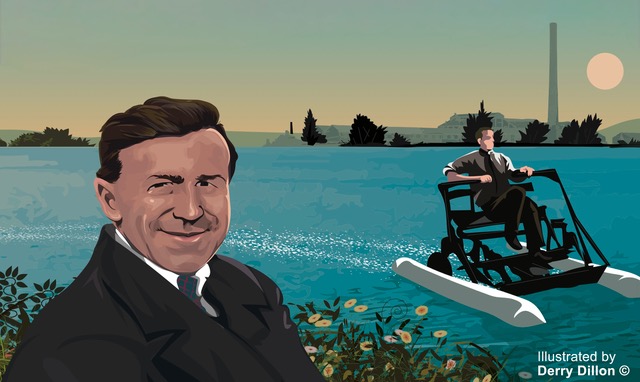
Franz Schwatschke. Illustration: Derry Dillon
Franz Schwatschke, Water-Bike Inventor
Ireland’s first sugar-processing plant was established in Carlow in 1926 and took in 79 consecutive beet harvests before its closure in 2005. One of its first engineers was Franz Schwatschke from Moravia in the present-day Czech Republic. Although he did not speak English, Franz settled in Carlow and married Charlotte Meredith, the daughter of a prominent land agent. Blessed with a tremendous talent for solving technical problems, he invented various electric motors and transformers, as well as the world’s first water-bike, which he tested on the River Barrow but never patented.
The Braun Factory
The great big murky green toaster shaped building you see approaching Carlow from Dublin is a Braun manufacturing plant. The Braun Factory was built by Sisk in 1974 to a design by the late horticulturalist and architect Angela Jupe (1944 –2021), head of the design team at the Industrial Development Agency. The site is in what was once the townland of Rathnapish on the north-eastern edge of Carlow town. The Läpple factory across from Braun, designed by RKD Architects, also opened in 1974 and closed in 2007.
The Braun Factory made small electrical appliances, as well as Oral-B toothbrushes in later years. At its peak, it employed over 1400 workers, mostly women.
One of my favourite remarks about it all was by Barry McKinley, a former draughtsman in Thompsons (Structural Steel Fabricators) who recalled how the female heavy factory upended the balance of the sexes in town. ‘There was a growing number of unemployed men walking around town with prams and bags of shopping! My girlfriend fled the country the moment her mother said, “I’m putting your name down for a job with the Germans”’.
By the time it closed in 2010, it still had 260 workers, of whom 100 were transferred to its Newbridge plant. In the autumn of 2021, the site, which covers about 30 acres and includes a large industrial facility, was sold by Procter & Gamble to a commercial property firm, Clyde Real Estate, led by entrepreneur Sean Gallagher. The site has been rezoned for “General Enterprise & Employment,” allowing for various enterprise uses such as offices, warehousing, and commercial services.
The site is currently home to NUA Manufacturing, which produces timber frames and light gauge steel elements for new homes and plans to employ around 200 people at this location.
See article by Emma Gilleece, architectural historian, here.
 Escape from Colditz
John Reid (1874-1934) from Grange, Co. Carlow, attended Blackrock College and played Gaelic football at club (Grange) and county level for Carlow. In 1902, he was appointed Secretary of the Carlow County GAA Board, where his father, also John, was a founder member and first treasurer. Having sat the British Civil Service Examinations, John was posted to India where he became Secretary of the Land Reform Department in Bihar and Orissa. He later received the King’s award of C.I.E. (Companion of the Order of the Indian Empire).
His son Pat Reid, MC, was born in Ranchi, India, on 13 November 1910. Educated at Clongowes Wood College and King’s College London, he then pursued civil engineering. At the outbreak of World War II, aged 28, he joined the Royal Army Service Corps. Captured in May 1940 near Cassel, France, Reid was imprisoned at Laufen Castle, near Salzburg. He and five others escaped in September 1940 but were soon recaptured and transferred to the impregnable prison, Colditz Castle in Saxony, where Reid became British Escape Officer. After numerous attempts, he successfully escaped to Switzerland in October 1942 via a marathon eleven-hour route within the prison.
Post-war, Reid wrote extensively about his POW experiences, beginning with The Colditz Story in 1952, which inspired a film starring John Mills and BBC series. He married three times—first to Jane Cabot in 1943, with whom he had five children. He died on July 21, 1991.
Those Kavanagh Men Again
Ted Kavanagh (1892–1958) was a British radio scriptwriter who wrote It’s That Man Again (ITMA), a hugely successful radio comedy series in the 1940s. Kavanagh, who had Carlow roots, appear as a guest on Desert Island Discs in 1951. His son P. J. Kavanagh (1931–2015) was a poet, columnist, Korean War veteran and actor who you might recall as the Nazi-memorabilia-collecting Father Seamus Fitzpatrick in Father Ted episode, “Are You Right There, Father Ted?”
Other Carlow Tales
Over the course of the 18th and 19th century, the borough and county of Ireland were largely represented in parliament by a member of the “Six B’s”, that is one of the six main landowning families in Carlow whose name happened to begin with B. These were Browne, Bruen, Butler, Bagenal, Beecher and Bunbury.
Despite the inevitable turbulence which flared up across Carlow – particularly during the 1798 Rebellion, the rise of Daniel O’Connell and the election of 1841 – Carlow Town enjoyed a period of relative prosperity during this era.
Like many an Irish town, Carlow had a booming industry in the export of woollen yarn to England. Notable buildings erected in the early 19th century included a grand Catholic Cathedral, the Greek Revival Court House, the Sisters of Mercy convent (which established the order in Pittsburgh, Pennsylvania) and a handsome train station to greet the Great Southern & Western Railway.
Carlow became the first town outside Dublin to have electric street lighting when the Alexander’s of Milford successfully creating a water-generator on the Barrow.
Pleasants Street in Dublin 8 is named for Thomas Pleasants (1729-1818), a Carlow-born merchant, property developer and philanthropist best known for helping Dublin’s Liberties (including the Meath Hospital) and for donating his library and considerable funds to the Royal Dublin Society.
William Dargan, the engineer and philanthropist known as ‘Father of the Irish Railway’, was born in Carlow in 1799.
George Bernard Shaw: The connection may be tenuous but GBS’s aunt and mothers’ family came from Carlow. The Nobel Laureate also donated over a dozen proprieties to Carlow. Over the past 60 years, the income generated from these properties has generated funding for numerous projects undertaken by voluntary organizations, including the erection and maintenance of a Christmas Crib on the Court House steps in Carlow town. On a national scale Shaw and his wife donated funds and legacies (worth millions today) to various projects in Ireland (the Irish National Gallery being a major recipient). One of the houses he donated during his lifetime was the premises in Dublin Street, for use as educational / training facility for the youth of Carlow. For many years, the Technical School was housed on the premises and it later housed the Carlow County Library. A plaque by his aunt’s house on Tullow Street describes Shaw as a “self-styled world betterer“. He was, after all, the man who said all this “struggling and striving” to make the world a better place was well and good but then pointed out that “struggling and striving” is the wrong way to go about anything at all.
Saoirse Ronan was an Ardattin schoolgirl when she was nominated as best supporting actress in both the Oscar and Golden Globe nominations 2007 for her pivotal role in the Ian McEwan adaptation, ‘Atonement’.
Richard D’Alton Williams (1822-1862), a member of the Young Ireland movement, was educated at St Patrick’s College, Carlow, before studying medicine at Saint Vincent’s Hospital, Dublin. He emigrated to the USA in 1851, practicing medicine until his death from tuberculosis in Thibodaux, Louisiana in 1862.
Sir Benjamin Baker designed the Forth Bridge in Scotland and the Barrow Bridge in Ireland. He was also the consulting engineer on the building of the Low Aswan Dam on the River Nile.
Manie Payne Ferguson (1850–1932) was a Carlow-born pioneer leader in the American Holiness Movement, a Christian evangelist and social worker. She co-founded the Peniel Mission, and the author of several hymns, most notably “Blessed Quietness”.
The father of Jimmy McCudden, the World War One ace, was born in Co Carlow. See The Irish Air Aces.
Patrick Dowling (1904-1999), an electrical engineer from Tinryland, is considered an ‘apostle of rural electrification’ after he helped bring electricity to over 99% of the population between 1947 and 1980.
The Gaelscoil Eoghain Uí Thuairisc in Ashgrove, Garrán na Fuinseoige, Tullow Road, Carlow, is named after Eoghan Ó Tuairisc (1919-1982), a notable Irish teacher, storyteller, and writer who lived in Carlow.
Carlow Fire Station launched first fire engine in the world powered by HVO in September 2024, a €462,000 engine.
‘When Carlow undertaker Rory Healy from R Healy & Son funeral directors realised there would be empty pews at a funeral he was organising in December 2024, he decided to do something about it. Mr Healy was concerned that the funeral of Mary Regan, a widow originally from Cork with no next of kin, would have few attendees. So he took to social media and launched an appeal asking people to come along so Ms Regan could get a proper Carlow send off . Over 300 people showed up. “It certainly restored my faith in humanity,” Mr Healy said.’
Carlow Brewing Company, also known as O’Hara’s Brewery, is the creator of stouts and ales, wheat beers and lagers. They win awards at all the right shows and they are all very, very drinkable.
SETU: The college has about 8000 students and almost 750 staff, full or part-time, as of 2018. Formerly known as Carlow IT, the college was merged with Waterford IT in 2022 to become the South East Technological University (SETU).
Shilling a Night, attrib. Rory Wadd
As I strayed into Carlow one day last July
I was making my way to the town of Athy.
My head it was weary
My pockets were light
All I had was a shilling for lodgings that night.
When I woke up in the morning I thought I’d go wild
The fire it was out , and no kettle boiled
Put her name on the paper
And make her do right
It’s an awful lie down for a shilling a night.
Now I remember a time when three pence was alright
But now they are charging a shilling a nite
With bugs and Highlanders
Twas bite after bite, twas an awful lie down for a shilling a night.
Now to conclude and to finish my song
Tis awful to think how a poor man gets on.
Go to bed hungry, and that isn’t right,
Then give the auld lady a shilling a night.

The Corrigans
There are a lot of people with the surname Corrigan in County Carlow. I thus wondered if one of them may have been a wild goose who settled in Brittany, France, and founded Korrigan’s Cidre Breton.
However, it seems the cider – produced by Romain Henin – refers to the korrigan, a fairy or dwarf-like spirit from Breton folklore in France. These spirits are often associated with dancing around fountains and guarding hidden treasures. The word korrigan means “small-dwarf” in Breton.
Now you know.
End-Notes
[1] The Browne’s Hill dolmen is one the reason why I became involved in “tourism” in the last years of the 20th century. I was assembling information on local historical curiosities for Carlow Tourism one summer. I particularly loved the dolmen, this mystical, inexplicable monument standing on its own surrounded by disinterested cattle and yawning sheep. Then I went away for a year. When I got back, the powers that be had stuck a pair of ugly Bruscar litter bins beside the dolmen, fenced it off and hammered a dreadful signboard depicting how life might have been for stone age dwellers beside it. I realised that this country requires guidance and so, in 1999, I joined a company called Trailblazer that sought to promote tourism. Before long, I also required guidance.
Acknowledgments
With thanks to Dr Margaret Murphy, Dermot Mulligan, Tom La Porte, Michael Purcell, Elaine Callinan, Michael Brennan and the team at Carlow Rootsweb for their miscellaneous pointers along the way.
*****
CEATHARLACH (Translations by Jack O’Driscoll)
AN DOLMAIN
Tuama adhlactha 6,000 bliain d’aois de dhéantús an duine is ea Dolmain Chnoc an Bhrúnaigh atá suite go díreach soir ó bhaile Cheatharlach. Meastar go bhfuil 103 tonna méadrach meáchain sa leac mhullaigh eibhir an-mhór síonbhuailte atá air. Tá sé sin beagnach chomh trom céanna le seacht n-eilifint Indiacha déag nó le scairdeitleán Boeing 757. Dá dtiocfadh foirne rugbaí na Nua-Shéalainne agus na Leon le chéile leis an gcéad imreoir is troime sa tSraith Náisiúnta Peile Meiriceánaí ó na Stáit Aontaithe, bheidís ag streachailt chun leac mhullaigh Chnoc an Bhrúnaigh a bhogadh oiread agus orlach amháin. Conas in Éirinn a cuireadh an leac mhullaigh in airde, más ea?

The effigy of William Marshal at the Temple Church, London. The damaged was caused during the London Blitz.
AN DOCHTÚIR PLÉASCACH
Ba é William Marshal a thóg an dúnfort cloiche ag Caisleán Cheatharlach. Bhí sé ar an ridire ab fhearr (agus ba shaibhre) lena linn. Ba í a bhean chéile, Isabel, an t-aon bhanoidhre amháin ag an mbarún Normannach Richard de Clare (Strongbow) agus ag Aoife, iníon Dhiarmaid Mhic Mhurchadha, Rí Laighean.
In 1213, cuireadh críoch leis an obair thógála ar dhaingean lárnach Cheatharlach. Bhí sé 70 troigh ar airde agus bhí ceithre thúr druma thart air. In 1814, cheannaigh An Dr Philip Middleton an caisleán agus é mar rún aige gealtlann a dhéanamh de. Nuair a rinne sé iarracht na fuinneoga a leathnú le púdar pléasctha, thit an dá thúr thoir anuas chomh maith le trí cheathrú de na ballaí taobh leo. Bhí an t-ádh dearg air nár gortaíodh aon duine.
PRIONSA ANTUAIRP
Sa bhliain 1361, thug Lionel Antuairp, Gobharnóir na hÉireann (agus mac Rí Éadbhard III Shasana), ordú don Státchiste athlonnú ó Chaisleán Bhaile Átha Cliath go Caisleán Cheatharlach. Nuair a bhog sé Cúirt na bPléadálacha Coiteanna go Ceatharlach an bhliain dár gcionn, ba iad na daoine seo a chuaigh a chónaí sa chaisleán: sirriam, constábla, fear cogaidh, beirt dlíodóirí agus ardsáirsint, chomh maith le roinnt bailitheoirí airgid agus cléireach agus ochtar boghdóirí. D’fhill an Státchiste agus an Chúirt ar Bhaile Átha Cliath tar éis do Lionel Éire a fhágáil in 1367. Fuair sé bás go luath ina dhiaidh sin agus é 29 bliain d’aois. Dúradh gur thug a athair céile Iodálach nimh dó.
DÚNMHARÚ IN HOLLYWOOD
Stiúir an fear de bhunadh Cheatharlach, William Desmond Taylor, 60 scannán tostach sular dúnmharaíodh é – scéal dochreidte atá ann – in Los Angeles in 1922. Ba é a athair an chéad chaptaen ar Bhriogáid Dóiteáin Dheonach Cheatharlach. Rugadh é sa Gharraí Nua ar Bhóthar Bhaile Átha Í. Chaith sé a óige in Elms House (ar a dtugtar The Elms anois), gar don Óstán Seven Oaks. Tar éis dó titim amach lena athair in 1889, d’imigh an fear 18 mbliana d’aois go Meiriceá agus chuaigh sé i mbun oibre ar rainse aíochta in Kansas. Faoin mbliain 1914, bhí sé ag stiúradh scannán – agus na mórphearsana scannáin, leithéidí Mary Pickford, mar aisteoirí aige iontu. Stiúir sé an chéad leagan scannáin de ‘Tom Sawyer‘, ‘Huckleberry Finn‘ agus ‘Anne of Green Gables’ (nó ‘Anne with an E‘ mar is fearr aithne uirthi anois). Scaoileadh marbh é agus tá an cás fós gan réiteach céad bliain ina dhiaidh.
AN CAOMHÁNACH UASAL IONTACH
Teachta Parlaiminte do Cheatharlach ó 1868 go 1880 ab ea Arthur Kavanagh. Nuair a rugadh in 1831 é, is amhlaidh a bhí stumpaí aige in áit rítheacha agus cosa faoin nglúin. D’éiligh a mháthair, bean shaibhir, go gcaithfí leis díreach faoi mar a chaithfí le haon duine eile dá páistí. Ní ba dhéanaí ina shaol, bhainfeadh sé cáil amach mar thaistealaí calma, mairnéalach, slatiascaire, sealgaire, grianghrafadóir amaitéarach, údar sárdhíola agus, murar leor é sin, bheadh seachtar clainne air. Nuair a bhí sé sna fichidí, thaistil sé thar tír ón gCríoch Lochlainn go dtí an Pheirs (An Iaráin) agus d’oibrigh sé mar fhear poist ar chósta thiar na hIndia.
AIREAGÓIR AN ROTHAIR UISCE
Bunaíodh an chéad mhonarcha phróiseála siúcra in Éirinn i gCeatharlach in 1926 agus bhí 79 fómhar biatais as a chéile curtha isteach aici sular dúnadh í in 2005. Bhí Franz Schwatschke as an Moráiv i bPoblacht na Seice an lae inniu ar dhuine de na chéad innealtóirí inti. Lonnaigh Franz i gCeatharlach agus phós sé Charlotte Meredith, iníon gníomhaire talún mór le rá – é sin go léir d’ainneoin nach raibh Béarla aige. Bhí an-luí aige le fadhbanna teicniúla a réiteach, cheap sé mótair leictreacha éagsúla agus claochladáin, chomh maith leis an gcéad rothar uisce ar domhan. Thástáil sé é ar an mBearú ach níor chuir sé paitinn air riamh.