
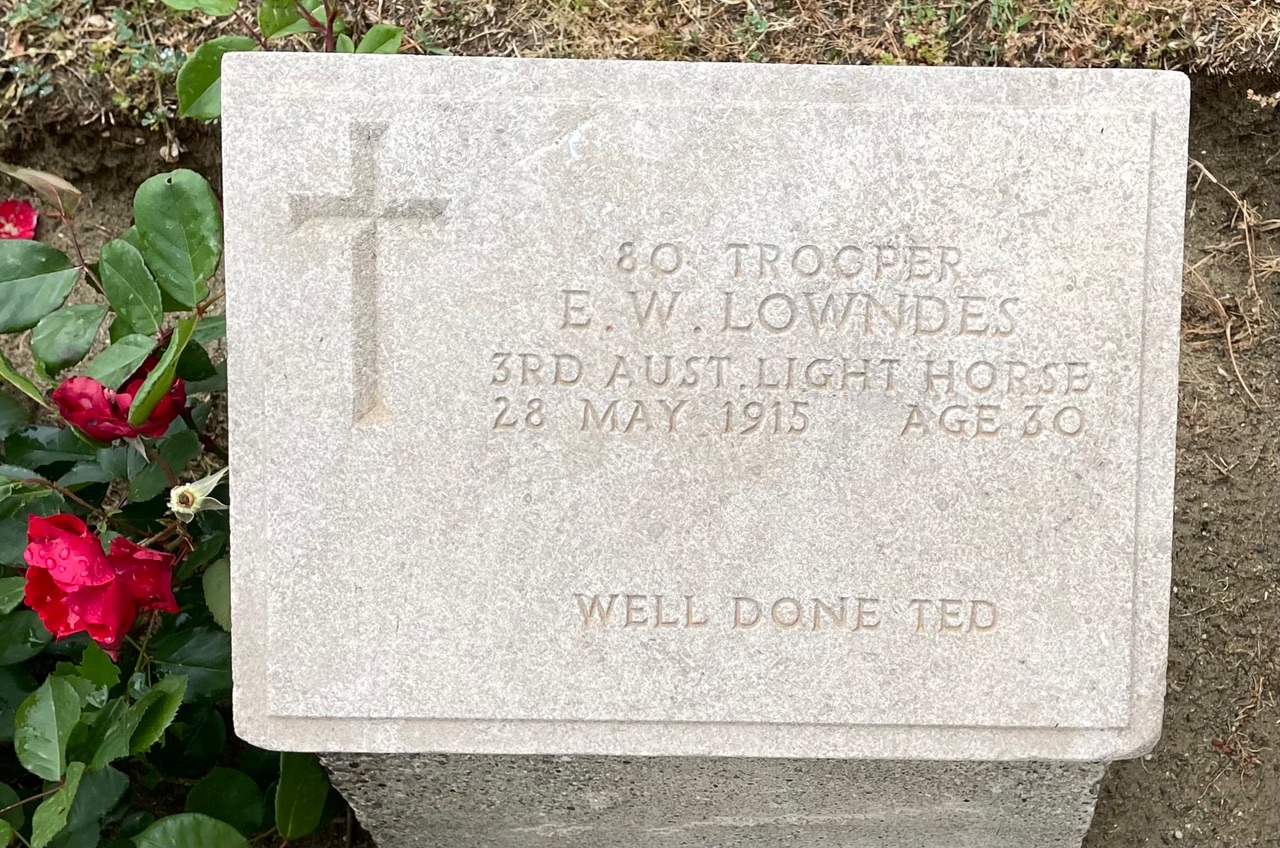
Ted’s grave at Beach Cemetery is Plot I, Row C, Grave No. I.
One of the most simple yet moving epitaphs that we found during our too-short visit to Gallipoli in May 2025 stood in the beautifully situated Beach Cemetery, near Anzac Cove. Inscribed on the headstone for Trooper Edward Whitaker Lowndes of the 3rd Australian Light Horse Brigade, were three words:
“Well done Ted”.
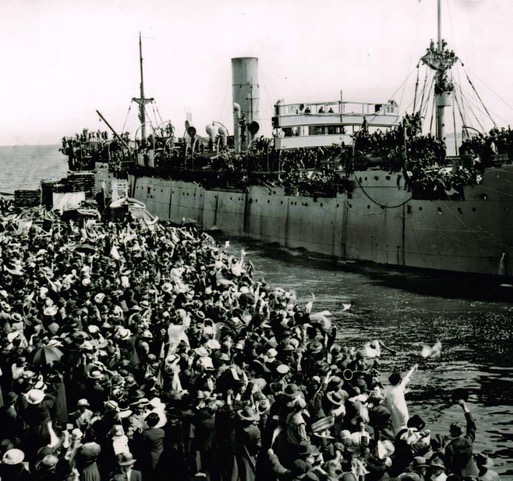
A17 SS Port Lincoln casting off from Port Melbourne dock on 20 October 1916. Ted sailed for Gallipoli on this same vessel in two years earlier. (AWM PB0868)
Upon our return home, I delved into the British News Archives and Australia’s Trove to find out more.
Ted, like Rohan, was a Cheltenham College old boy. Born in Cainscross, Stroud, Gloucester, on 9 September 1884, he was the second son of Robert Baxter Lowndes and his wife Marian (née Whitaker) of Waverley, Cuckfield, West Sussex. Marian’s father Joseph Whitaker (1820–1895) was the author and publisher of Whitaker’s Almanack.
Ted had served during the Anglo-Boer War and was working with the commercial staff of the Daily Herald in Adelaide, Australia, when the war broke out.
On 19 August 1914, he enlisted at Morphetville, South Australia, as a corporal in the 3rd Australian Light Horse Brigade. At the time, the 31-year-old was 5 foot six, and weighted 141 lbs.
On 22 October 1914, the brigade embarked from Adelaide, without horses, on board HMAT A17 Port Lincoln, a converted cargo ship.
Destination Egypt and, ultimately, Gallipoli.
His regiment had landed at Gallipoli from Egypt on 12 May 1915 as part of the New Zealand and Australian Division. He died of his wounds just 16 days later – one of 2,298 Australians who lost their lives that May. The cause of his wounds are, as yet, unknown.
On 6 August 1915, having learned the new of his death, the Daily Herald published this obituary to him on p. 6, alongside his portrait photograph:
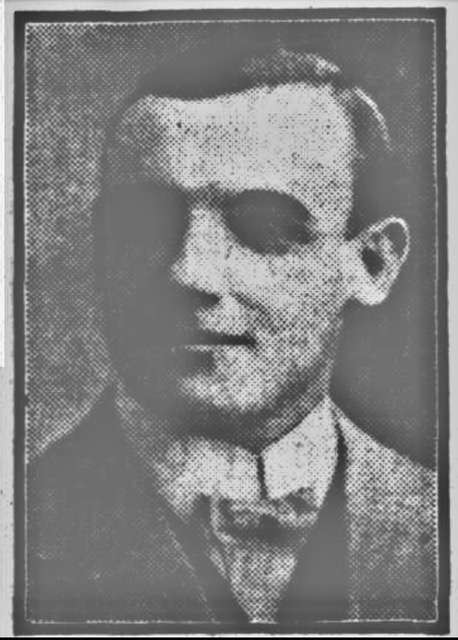
Ted Lowndes (1884-1915)
THE LATE CORPORAL E. W. LOWNDES.
One of the first to offer and to be accepted for service with the South Australian quota of the Commonwealth expeditionary force was Mr. E. W Lowndes, of the commercial staff of “The Daily Herald.”
General regret was expressed when news was received yesterday that Corporal Lowndes, who had been wounded in the Gallipoli campaign, had died.
He was attached to the 3rd Light Horse, and left Egypt for the front on May 8. Although comparatively young in years he was an old soldier. When 16 years of age, he joined a Light Horse regiment in South Africa and operated in Cape Colony and the Orange Free State. Later, he enlisted in the 1st Imperial Light Horse, and served in the Transvaal on the Bechuanaland land border, and in the notorious Marica desert.
In 1906 he accompanied a small expeditionary force into Zululand. Afterwards the ranks of 14th Hussars hailed him as a comrade, and after spending some time in this Imperial regiment at Shorncliffe, he sailed with the unit, for India. The Hussars were stationed Bangalore, and at least one exciting experience in which Mr. Lowndes shared came the way of the regiment – the Moplah rebellion.
After serving a couple of year in the over-warm country, Mr. Lowndes purchased his discharge, and in 1908 came to South Australia.
He has always taken a keen interest in union matters, and was one of the founders, and until recently, the president, of the S.A. branch of the Clerks’ Union.
Ted’s next-of-kin was stated to be his sister Miss Eva Lowndes, Huckfield, Sussex, England, but his Imperial War Museum record here names several other siblings.
Ted’s elder brother Robert Clayton Baxter Lowndes also died relatively young, as per this account from the Mid Sussex Times, 9 December 1919, p. 5:
‘The death took place on Thursday, at the residence of his mother, of Mr. Robert Clayton Baxter Lowndes, after a long and painful illness. Mr. Lowndes, who was thirty-eight years of age, was the eldest son of Mrs. Lowndes, of Waverley, High Street, and was educated at Cheltenham College and St. Edward’s School, Oxford. He was for some time British Pro-Consul of Algiers. Mr. Lowndes was the eldest grandson of Mr. Joseph Whitaker, author of Whitaker’s Almanack, and for many years Mr. Lowndes took a prominent part in the compilation of the book. Eventually lung trouble made it necessary for him to give up literary work and seek fresh air on esparto grass gathering in Algeria. During the war, Mr. Lowndes of course enlisted, but being only fit for clerical work he was employed at the British Consulate at Algeria, where he became Pro-Consul. Unfortunately indoor life brought on the old lung trouble, and, after a severe illness he returned to England and had been at Cuckfield since June. This is the second son Mrs. Lowndes has recently lost. The second son, Edward Whitaker Lowndes, 3rd Australian Light Horse, died from wounds May, 1915.’
You can find further tales of Gallipoli and the First World War here.

Frontispieces from Whitaker’s Almanac and Whitaker’s Peerage from 1915, the year Ted died. The publishing house J. Whitaker & Sons was established by his grandfather, Joseph Whitaker.
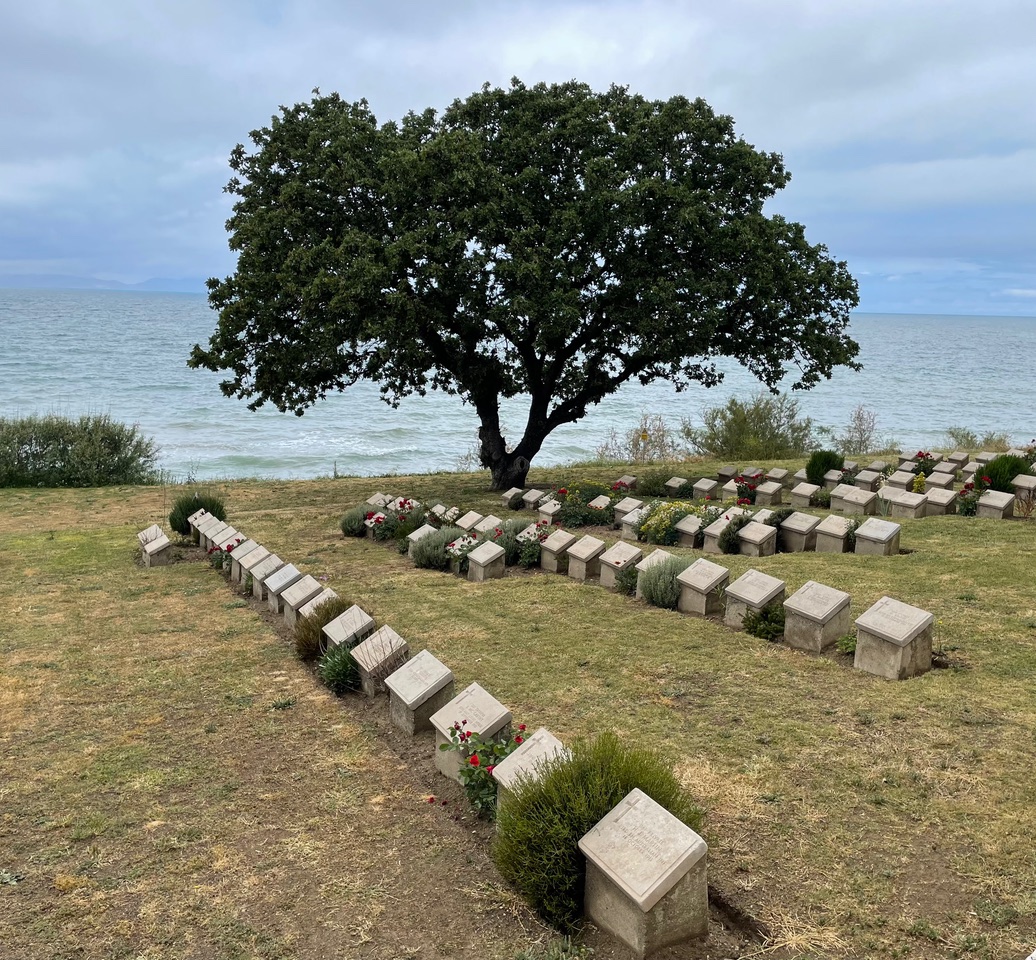
Beach Cemetery at Gallipoli, located at Hell Spit near Anzac Cove, contains 391 Commonwealth servicemen from World War I, mostly Australian, New Zealand, and British soldiers who died during the 1915 Gallipoli campaign. Also here is Private John Simpson Kirkpatrick, the ‘Man with the Donkey’, who made his name as a stretcher-bearer during the Gallipoli campaign, famously using a donkey to carry wounded soldiers from the front lines to safety under heavy fire. Also here were Major C. H. Villiers –Stuart, whose family I have written about here, and Corporal T. H. Mc Enery, 4th Bn. Australian Infantry, who died on 27 May 1915, aged 18. He is described on his headstone as a ‘grandson of Timothy Mc Enery of Tralee, teacher of Dublin College.’


Daily Herald (Adelaide, SA), 6 Aug 1915, p. 6.